Table of Contents
ToggleIf you have been diagnosed with cancer in India in 2026, there is a good chance someone has mentioned genetic testing to you.
Maybe your oncologist ordered an EGFR test. Or a BRCA test. Or a basic NGS panel covering 20-50 genes.
You waited two weeks, got a report, and either found something actionable; or didn’t.
What most patients and even many oncologists don’t realise is that these tests, valuable as they are, represent a fraction of the molecular information available about any given tumour.
Comprehensive genomic profiling is different. And the difference is not incremental; it is the difference between reading a chapter and reading the whole book.
So What Exactly Is Comprehensive Genomic Profiling?
Comprehensive genomic profiling (CGP) is a type of advanced molecular testing that analyses hundreds or thousands of cancer-related genes simultaneously from a single tumour sample. Rather than testing for one specific mutation in one specific gene, CGP interrogates the entire relevant genomic landscape of a cancer at once.
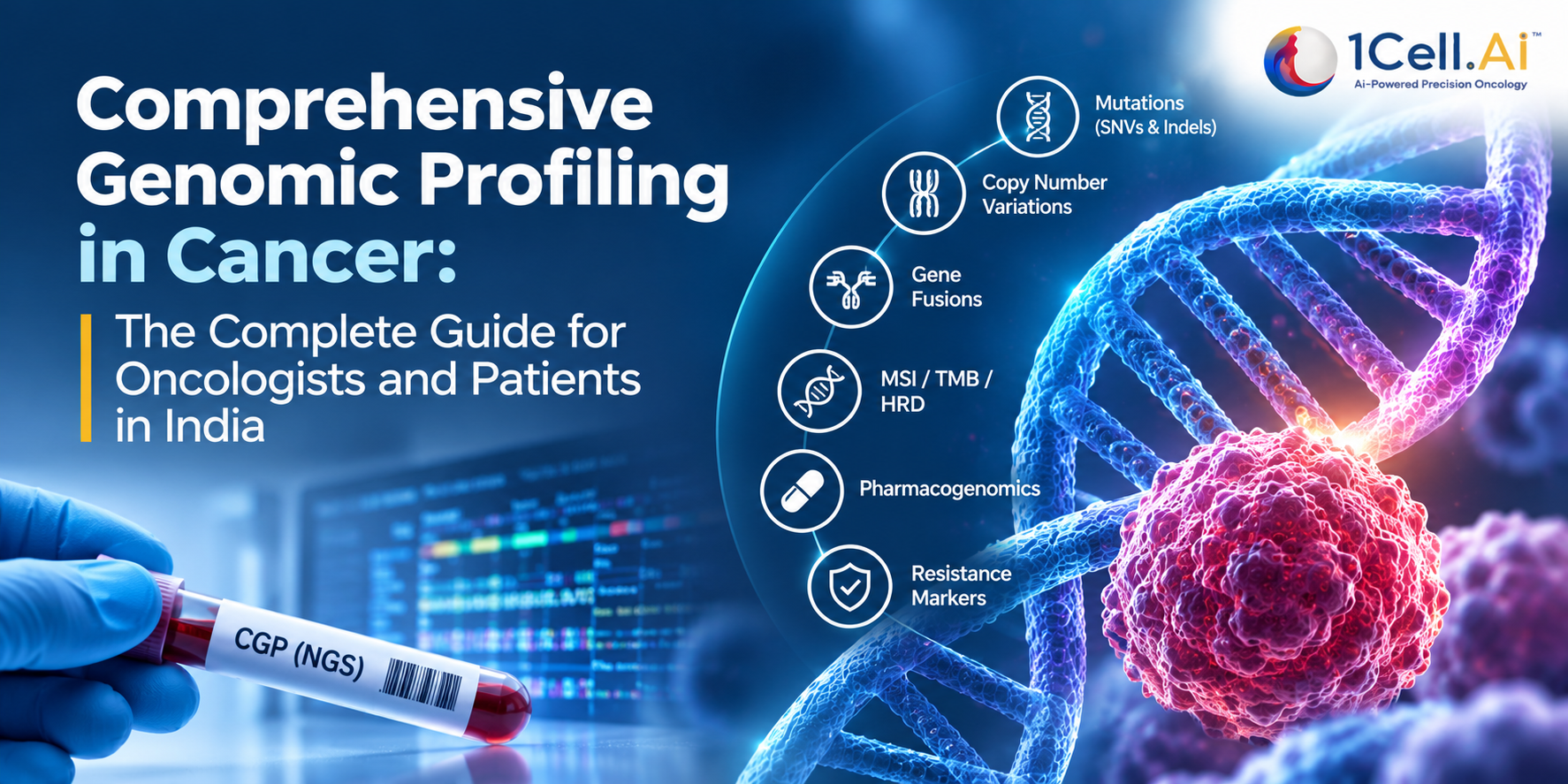
A properly comprehensive panel covers:
- SNVs and indels – point mutations and small insertions or deletions across cancer-driving genes
- Copy number variations – regions of DNA that are amplified or deleted
- Gene fusions – abnormal joins between two genes that can create powerful cancer drivers
- Microsatellite instability (MSI) – a marker that predicts immunotherapy response
- Tumour Mutational Burden (TMB) – the total number of mutations, another immunotherapy predictor
- Homologous Recombination Deficiency (HRD) – the genomic scar pattern that predicts PARP inhibitor response
- Pharmacogenomic markers – variants that determine how a patient processes specific chemotherapy drugs
- Resistance markers – mutations that explain why a previous treatment stopped working
All of this from one specimen. One report. One clinical conversation!!!!
How Is It Different From Standard Cancer Gene Testing in India?
This is the question worth asking clearly because the difference is significant and has real consequences for treatment decisions.
| Single-gene / Small Panel Testing |
Comprehensive genomic profiling
|
|
| Genes tested | 1 to 50 | 300 to 1,080+ |
| Fusions detected | Limited | Comprehensive |
| MSI / TMB / HRD | Often missing | Included by default |
| Pharmacogenomics | Rarely included |
Standard
|
| Tissue required | Per test | Once – single specimen |
| Turnaround | Per test | One report |
| What you miss | Everything outside the panel |
Very little
|
The most common testing approach in India today is sequential single-gene testing – order EGFR, wait.
If negative, order ALK, wait.
If negative, order ROS1, wait again.
Each test takes time, consumes precious tissue, and most critically; each negative result only tells you what isn’t there, not what is.
comprehensive genomic profiling answers all of those questions in a single run. And it finds things sequential testing would never reach – the unexpected FGFR2 fusion, the co-occurring HRD score, the DPYD variant that would have caused severe chemotherapy toxicity at standard dosing.
Why Does This Matter Specifically in India?
Over 70% of cancer cases in India are diagnosed at advanced stages. At that point, time is the most precious resource a patient has. Frankly speaking time is life.
Sequential testing, with its two-to-three-week waits per gene, is a strategy that advanced cancer simply doesn’t give patients the luxury of.
There is also the tissue problem. Many Indian patients with advanced cancer; particularly lung, pancreatic, or deep-seated tumours- have limited tissue available from biopsy. Every single-gene test consumes a portion of that tissue. By the time you have run four or five sequential tests, there may not be enough tissue left for the test that actually finds something.
CGP uses tissue once. The rest is computation.
And then there is the access gap. Tools like Oncotype DX and MammaPrint – the gold standard genomic tests for breast cancer recurrence; cost ₹1-2 lakhs and require sequencing infrastructure unavailable in most Indian hospitals. The promise of comprehensive genomic profiling in India is not just more information. It is the right information, accessible, from a single blood draw or tissue specimen, without sending samples abroad.
What comprehensive genomic profiling Finds That Changes Treatment?
This isn’t all theoretical, let’s show it to you in practical situations. Here is where the clinical impact becomes concrete.
In our analysis of 124 cancer patients across multiple tumour types using our OncoIndx® comprehensive genomic profiling panel – including a significant cohort from the Uzbek population; we identified 331 pathogenic or likely pathogenic variants across the cohort. Key oncogenic drivers included TP53, PIK3CA, APC, KRAS, EGFR, PTEN, and BRCA1/2 – all representing actionable targets for existing or emerging therapies.
Three patients with colon and lung cancers exhibited high microsatellite instability (MSI):- a critical biomarker for immunotherapy eligibility that would have been entirely missed without a comprehensive panel, since MSI testing is not standard in basic gene panels.
In a separate pharmacogenomic analysis of 124 patients, 36 PGx markers across the cohort identified patients at significant risk of toxicity from standard chemotherapy agents; including DPYD variants predicting fluoropyrimidine toxicity and UGT1A1 variants predicting irinotecan-related adverse events.
None of these findings are available from standard targeted gene panels!!!
This is what comprehensive genomic profiling finds. These are not theoretical benefits; they are treatment decisions that changed because the right test was ordered.
When Should Comprehensive Genomic Profiling Be Ordered?
Not every cancer patient needs CGP at every stage. And let’s be practical, it’s kind of costly. But it is particularly valuable in the following situations- and in India’s context, increasingly essential:
- At diagnosis for advanced cancer – particularly for lung, colorectal, ovarian, pancreatic, and breast cancers, where multiple actionable drivers may exist and treatment selection depends on molecular information
- When standard targeted testing returns negative – a driver-negative result on a small panel is not the same as a driver-negative result on a comprehensive panel. Before concluding there is nothing actionable, CGP should be the next step
- Before second-line or later-line treatment decisions – when first-line therapy has failed, understanding resistance mechanisms requires the breadth that CGP provides
- For cancer of unknown primary (CUP) – where tissue of origin is unclear, comprehensive molecular profiling including our Molecular Similarity Score can help anchor the diagnosis
- For patients seeking alternatives to chemotherapy – CGP identifies targeted therapy and immunotherapy options that standard testing cannot
One Panel. Three Layers. The Complete Picture.
At 1Cell.Ai, our OncoIndx® panel delivers comprehensive genomic profiling across 1,080 genes on a Whole Exome Sequencing backbone- integrating DNA, RNA transcriptomics, and protein profiling from a single tissue specimen or blood draw.
The report covers SNVs, indels, copy number variants, 50 gene fusions across 138 partners, HRD scoring, TMB, MSI, 350 resistance genes, and 36 pharmacogenomic markers – all in one integrated, therapy-ready document, reported per AMP/ASCO/CAP and ACMG guidelines, in 12 days from our CAP-accredited laboratory.
Because in advanced cancer, the question is never just “what mutation does this patient have?”
It is
“What is the complete molecular story of this tumour and what does it mean for treatment?”
comprehensive genomic profiling is how that question gets a real answer.