

Table of Contents
ToggleFor the first time in decades, a drug doubled survival in pancreatic cancer. The standing ovation at ASCO 2026 was deserved. But the most important question isn’t about the drug; it’s about who gets it. On May 31, 2026, something happened at the ASCO Annual Meeting in Chicago that oncologists had been waiting decades for.
Brian Wolpin, MD, MPH– Director of the Hale Family Center for Pancreatic Cancer Research at Dana-Farber Cancer Institute; stepped to the podium at the plenary session and presented a slide that the audience had never seen for pancreatic cancer before.
A survival curve that bent upward.
Meaningfully. Dramatically.
In a disease where progress has been measured in weeks, not months. The room gave him a standing ovation before he finished speaking.
The Drug, The Trial, The Numbers
Daraxonrasib is an oral RAS(ON) multiselective inhibitor developed by Revolution Medicines. It targets KRAS, the most commonly mutated oncogene in pancreatic cancer, present in approximately 90% of PDAC cases– in its active, GTP-bound state. For four decades, KRAS was considered undruggable.
Too smooth, too dynamic, no viable binding pocket for a drug molecule to grip. To perfect a villain to win over.
That assumption is now officially retired.
The Phase 3 RASolute 302 trial enrolled 500 patients with metastatic pancreatic ductal adenocarcinoma (mPDAC) who had progressed on one prior line of standard chemotherapy – one of oncology’s most difficult patient populations, where median survival on second-line chemotherapy has historically been 6 to 7 months.
The results, published simultaneously in the New England Journal of Medicine on May 31, 2026:
| Outcome | Daraxonrasib | Chemotherapy | Difference |
| Median Overall Survival | 13.2 months
|
6.7 months
|
Nearly doubled
|
| Median PFS | 7.3 months | 3.5 months | More than doubled |
| Risk of death reduction | 60% (HR 0.40, p<0.0001) | —
|
Unprecedented |
| Treatment discontinuation due to side effects | Lower
|
Higher
|
Better tolerability
|
These results reduced the risk of death by 60% – a result not previously reported in any Phase 3 clinical trial in any line of therapy for this disease.
On August 26, 2026: six and a half months ahead of schedule; the FDA approved daraxonrasib under the brand name Rasonque, making it the first-in-class targeted therapy approved for metastatic pancreatic cancer. Revolution Medicines received Breakthrough Therapy, Orphan Drug, and Priority Review designations
To put this in human terms: patients who previously had roughly six months to live after failing first-line chemotherapy now have, on average, more than a year. That is not a statistical abstraction. That is six months of life that did not exist before this trial.
Why This Took 40 Years
The KRAS story in cancer biology is one of the most frustrating in modern medicine.
KRAS was identified as a cancer-driving oncogene in the 1980s. For four decades, it was the most frequently mutated gene in human cancer, and the one that drug developers could not touch. Every attempt to directly inhibit KRAS failed. The protein’s surface was too smooth, its affinity for GTP too high, its structure too dynamic.
In simple terms – undefeatable.
The breakthrough came in 2019 when researchers at Revolution Medicines and others developed a new conceptual approach – targeting KRAS in its active, GTP-bound “ON” state rather than trying to block it from binding GTP in the first place. The RAS(ON) inhibitor approach was born.
Sotorasib became the first KRAS-targeted therapy approved by the FDA – for KRAS G12C in lung cancer, in 2021. But daraxonrasib goes further. It is multiselective, targeting not just G12C but multiple KRAS G12 variants (G12C, G12D, G12V, G12R, G12A, G12S, G13) and wild-type RAS. This breadth is what makes it particularly relevant for pancreatic cancer, where KRAS G12D is the dominant mutation rather than G12C.
For the first time, a targeted therapy has doubled overall survival compared to standard chemotherapy in second-line metastatic PDAC. Daraxonrasib validates the RAS(ON) inhibitor approach and establishes a new standard of care, pending regulatory approval.
The Question Nobody Is Asking Loudly Enough
Here is where the daraxonrasib story gets more complicated, and more interesting.
The trial showed benefit regardless of RAS mutation status, including in patients whose tumours did not harbour detectable RAS mutations. This is both exciting and puzzling. It suggests the drug may have mechanisms of action beyond simple RAS inhibition; or that current testing methods are missing RAS mutations that are genuinely present.
But there is a deeper question. One that our own research- presented at ASCO 2026, just days before the RASolute 302 plenary – speaks to directly.
What about the patients whose tumours harbour KRAS-independent subclones?
In our ASCO 2026 study of 16 metastatic PDAC patients, conducted in collaboration with the Medical College of Wisconsin Cancer Center, we found something that changes the daraxonrasib conversation significantly:
KRAS mutations detected in ctDNA were absent in matched CTC-DNA in multiple patients; revealing circulating tumour cell populations that are biologically independent of the dominant KRAS-mutant clone detected by standard liquid biopsy.
In those KRAS wild-type CTCs, we found co-occurring TP53 alterations alongside activation of MAPK/RTK, PI3K-AKT-mTOR, and TGFβ/SMAD pathways- entirely different oncogenic drivers operating independently of KRAS.
What does this mean for daraxonrasib?
It means that even for a patient who responds beautifully to daraxonrasib – whose KRAS-mutant clone is suppressed by the drug, there may be a population of KRAS-independent tumour cells circulating in their blood, driven by different pathways, potentially resistant to RAS inhibition, and capable of driving future progression.
This is not a theoretical concern. It is a biological reality that comprehensive genomic profiling of both ctDNA and live CTCs can now detect; and one that standard tumour testing simply cannot capture.
The Patient Selection Problem; And Why It Matters Right Now
Daraxonrasib is likely heading toward FDA approval. When it gets there, oncologists across India, the US, and the world will face an immediate clinical question: which patients should receive it, and how do we monitor them?
The answer to both questions runs through molecular testing.
For patient selection:
RASolute 302 showed benefit across RAS mutation statuses, but the benefit was most pronounced in KRAS G12-mutant patients, who make up the vast majority of PDAC cases. Identifying which specific KRAS variant a patient carries is now clinically essential because as combination strategies and next-generation RAS inhibitors emerge, the specific mutation will determine which drug or combination works best.
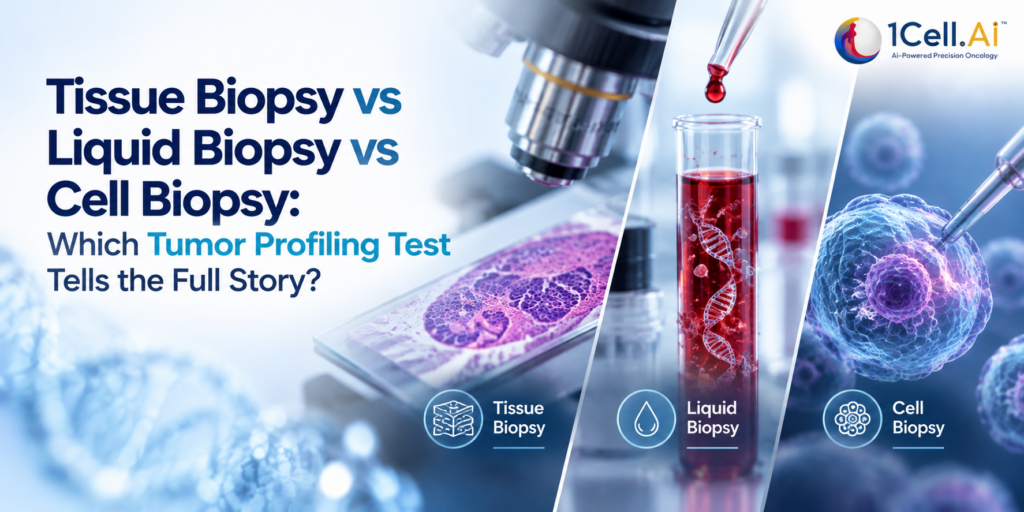
A standard tissue biopsy or basic ngs test for cancer will identify the dominant KRAS variant. But as our data showed, it will miss the KRAS-independent subclones that may determine long-term treatment response.
This is where comprehensive genomic profiling, integrating ctDNA and single-cell CTC analysis , changes the picture. Our OncoIndx® 1,080-gene panel, combined with OncoIncytes™ live CTC profiling, can simultaneously:
- Confirm the KRAS variant driving the dominant tumour clone
- Identify co-occurring mutations (TP53, SMAD4, CDKN2A) that affect prognosis
- Detect KRAS-independent CTC subpopulations that may not respond to RAS inhibition
- Profile PI3K-AKT-mTOR and other pathway activations in those subclones – potential targets for combination therapy
For monitoring during treatment:
Daraxonrasib will inevitably face resistance.
All targeted therapies do. The question is whether oncologists can catch resistance emerging, before it manifests as clinical or radiological progression; and adapt treatment accordingly.
This is exactly what longitudinal CTC and ctDNA monitoring delivers. In our ASCO 2026 data, serial CTC profiling across up to five timepoints captured dynamic clonal evolution, including the emergence of PI3K-AKT-mTOR pathway activation post-treatment, consistent with acquired resistance to RAS-directed therapy.
minimal residual disease testing in this context isn’t just about detecting leftover cancer after surgery. It is about watching, in real time, how a tumour evolves under drug pressure and getting ahead of resistance before it takes hold.
What This Means for Patients Right Now
If you or someone you love has been diagnosed with metastatic pancreatic cancer, here is what the daraxonrasib story means practically:
- Ask about KRAS testing. Before any second-line treatment decision, your oncologist should know which KRAS variant( if any) is driving your cancer. This requires a molecular test, not just standard pathology. A tumor profiling test that covers all KRAS G12 variants is now essential in PDAC management.
- Ask whether your liquid biopsy is capturing the complete picture. Standard ctDNA testing misses KRAS-independent subclones; as our data showed. Ask whether CTC profiling is available and appropriate for your situation.
- Ask about molecular monitoring during treatment. If you are on daraxonrasib or will be, serial ctDNA and CTC monitoring can detect emerging resistance earlier than any scan. Ask your oncologist whether this is part of your follow-up plan.
The Bigger Picture: Precision Oncology India and the KRAS Revolution
For precision oncology india, the daraxonrasib story carries particular weight.
Pancreatic cancer in India carries a mortality-to-incidence ratio of approximately 0.93 – meaning that nearly everyone who is diagnosed dies from the disease. Historically, this has been attributed to late-stage diagnosis and limited access to effective treatment.
“Rasonque (daraxonrasib) – now FDA approved and moving toward broader global access, could fundamentally change the second-line treatment landscape for Indian PDAC patients.”. But that change will only be realised if the molecular testing infrastructure to identify eligible patients and monitor them during treatment, keeps pace.
At 1Cell.Ai, our dual ctDNA and CTC profiling platform was built for exactly this moment. Not because we anticipated daraxonrasib specifically, but because we understood that every targeted therapy breakthrough in oncology creates a new and urgent need for more precise patient selection and more sensitive treatment monitoring.
The drug has arrived. The diagnostics need to meet it.
Conclusion: The Standing Ovation Was Just the Beginning
Daraxonrasib is a landmark.
A standing ovation at ASCO is a rare thing, and in pancreatic cancer, one of the rarest. The RASolute 302 data deserved every second of it- and the FDA agreed, approving Rasonque (daraxonrasib) on August 26, 2026, months ahead of schedule.
But the standing ovation marks a beginning, not an ending.
Because doubling survival in previously treated metastatic PDAC, as extraordinary as that is still means a median overall survival of 13.2 months. There is more work to do.
Resistance will emerge. Subclones will evolve.
New combinations will need to be tested.
Every one of those challenges runs through the same answer: know your tumour more completely. Not just its dominant KRAS mutation. Not just what the ctDNA shows. But what the live tumour cells in the bloodstream are doing – right now, in real time, at the level of individual cells.
That is what comprehensive genomic profiling of CTCs and ctDNA together delivers. And for pancreatic cancer patients in 2026, that level of molecular intelligence has never mattered more.
At 1Cell.Ai, our OncoIncytes™ platform and OncoIndx® comprehensive genomic profiling panel are built for the era of targeted therapy in pancreatic cancer; from patient selection to treatment monitoring to resistance detection. To learn more, visit 1cell.ai or reach us at [email protected]