
Pancreatic Cancer’s Moving Target:-
Pancreatic ductal adenocarcinoma (PDAC) remains one of the most lethal cancers and one of the hardest to treat precisely, because it doesn’t stay still. PDAC tumours exhibit profound intratumoral heterogeneity, with multiple genetically distinct cell populations evolving rapidly under treatment pressure. Conventional tissue biopsy and bulk ctDNA analysis, both of which sample the tumour at a single point in time and at a population level, simply cannot keep pace with this evolution.
Recent research has identified KRAS-independent tumour subclones within KRAS-mutant PDAC- populations of cancer cells that appear to be driven by entirely different oncogenic pathways than the dominant KRAS mutation. If true, this has major implications for treatment resistance. But detecting these subclones requires a tool with far higher resolution than bulk genomic profiling can offer.
This study, conducted in collaboration with the Medical College of Wisconsin Cancer Center under an IRB-approved protocol (NCT05802069), set out to determine whether longitudinal single-cell CTC genomics could reveal these hidden subpopulations and complement matched ctDNA profiling in patients with metastatic PDAC.
Our Approach: Paired Single-Cell CTC and ctDNA Profiling Over Time:-
Sixteen advanced metastatic PDAC patients were enrolled, with serial blood collection at baseline and every 3 months for up to 12 months, generating up to five serial timepoints per patient.
At each timepoint, live single CTCs were isolated using our OncoIncytes™ platform, and individual CTC-DNA was profiled using our OncoIndx™ 1080-gene panel. In parallel, matched ctDNA was analysed at 8,000x sequencing depth. All variant calling and analysis was performed using our iCore™ platform, enabling direct, timepoint-by-timepoint comparison between single-cell CTC-DNA and bulk ctDNA.
What We Found:-
The results reveal a genomic landscape that bulk ctDNA alone simply cannot see:
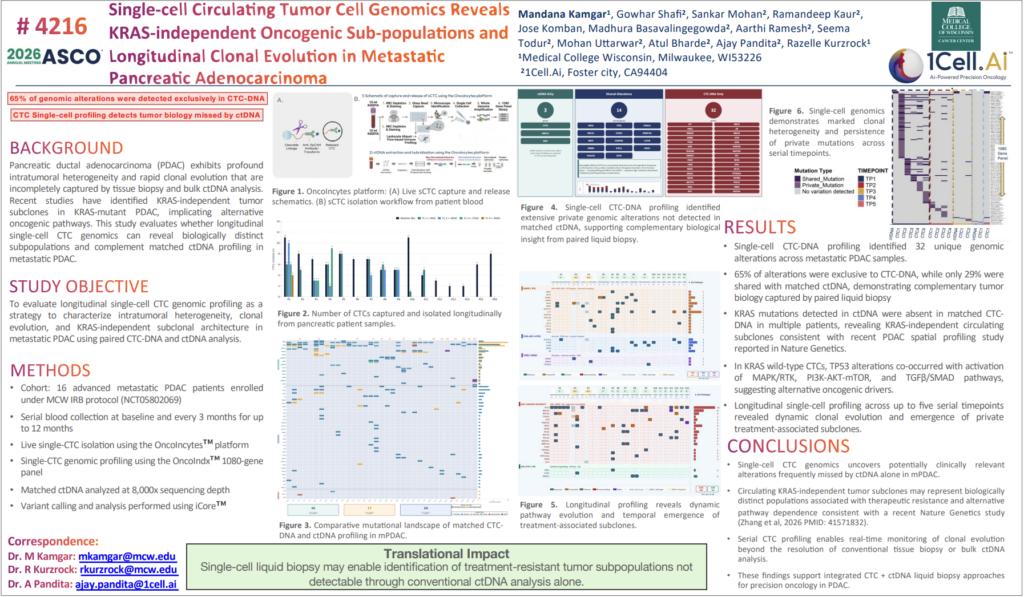
- 32 unique genomic alterations were identified across CTC-DNA from metastatic PDAC samples
- A striking 65% of these alterations were exclusive to CTC-DNA- detected nowhere in matched ctDNA, while only 29% were shared between the two, demonstrating that paired liquid biopsy captures genuinely complementary tumour biology
- KRAS mutations detected in ctDNA were absent in matched CTC-DNA in multiple patients, revealing KRAS-independent circulating subclones, consistent with a recent PDAC spatial profiling study published in Nature Genetics (Zhang et al., 2026)
- In KRAS wild-type CTCs, TP53 alterations co-occurred with activation of the MAPK/RTK, PI3K-AKT-mTOR, and TGFβ/SMAD pathways, pointing to alternative oncogenic drivers operating independently of the canonical KRAS pathway
- Longitudinal single-cell profiling across up to five serial timepoints revealed dynamic clonal evolution, with private, treatment-associated subclones emerging over time- clonal heterogeneity and persistence patterns that only single-cell resolution could capture
Why This Matters:-
These findings carry significant translational implications for how PDAC is monitored and treated. Single-cell CTC genomics uncovers potentially clinically relevant alterations that are frequently missed by ctDNA alone in metastatic PDAC, meaning that patients managed on ctDNA monitoring alone may have an incomplete picture of their disease’s evolving genomic landscape.
The discovery of circulating KRAS-independent tumour subclones is particularly significant. These populations may represent biologically distinct subpopulations associated with therapeutic resistance and alternative pathway dependence- a finding that aligns with emerging spatial profiling research and suggests that KRAS-targeted therapies alone may leave these subclones unaddressed, allowing them to expand and drive resistance.
Perhaps most importantly, serial single-cell CTC profiling enables real-time monitoring of clonal evolution at a resolution beyond conventional tissue biopsy or bulk ctDNA analysis, giving oncologists a genuinely dynamic view of how a patient’s tumour is changing, timepoint by timepoint, in response to treatment.
Translational Impact:-
Single-cell liquid biopsy may enable the identification of treatment-resistant tumour subpopulations that are simply not detectable through conventional ctDNA analysis alone, supporting the case for integrated CTC + ctDNA liquid biopsy approaches as the new standard for precision oncology in PDAC.
We are deeply grateful to our collaborators at the Medical College of Wisconsin Cancer Center- Dr. Mandana Kamgar and Dr. Razelle Kurzrock, for their partnership in this important work, which represents another step toward truly real-time, single-cell-resolution precision oncology for one of the most challenging cancers in medicine.
Presented by Mandana Kamgar, MD, MPH et al. | Medical College of Wisconsin & 1Cell.ai | ASCO Annual Meeting 2026
Read Abstract