

One Test. Inherited Risk. Personalized Prevention.
AI-powered germline profiling identifies inherited cancer-risk variants to guide earlier screening, prevention, family testing, and treatment planning.
~20,000 genes
Whole exome sequencing
28 genes
MLPA copy-number coverage
Hereditary risk
Clinical focus area
Decision-ready
Structured report output
Why It Matters
Hereditary risk changes what happens next.
Germline results are not just diagnostic. They reshape prevention, family testing, and targeted therapy decisions across the care continuum.
10–15%
HEREDITARY SHARE
Of common cancers are hereditary. Identifying carriers redirects prevention and screening.
ASCO · ESMO
GUIDELINE-SUPPORTED
Reporting maps to recognized clinical management pathways.
5–10y
EARLIER DETECTION
Earlier detection windows create opportunity to intervene at pre-symptomatic stages.


WHY ONCORISK®
Comprehensive germline Profiling. In a single test.
Between 10–15% of common cancers are driven by inherited pathogenic variants. Identifying these variants early transforms prevention, surveillance, and treatment for patients today and their relatives tomorrow.
OncoRisk® consolidates hereditary cancer risk assessment into one clinically validated workflow, engineered for oncology teams that need reproducible, decision-ready results.
WHOLE EXOME SEQUENCING
Genome-wide coverage across approximately 20,000 genes.
MLPA
Large deletion and duplication analysis across 28 genes.

Comprehensive hereditary risk assessment
Converged into a decision-ready report
Methodology
NGS + MLPA. Two methods. One report.
Complementary assays converge into a single integrated hereditary cancer report.
01
Next-Generation Sequencing
Excellent for identifying single-nucleotide changes and small insertions or deletions.
- Single nucleotide variants
- Small indels
- Splice-site changes
02
MLPA
Measures exon-level copy number changes and helps detect large deletions or duplications.
- Single and multi-exon deletions
- Duplications
- Large rearrangements
Copy-number findings are detected and confirmed within the same workflow rather than requiring a separate test.
01
Deep-level resolution
Deep-level reads for targeted areas support confident calls.
02
Orthogonal confirmation
Copy-number calls from sequencing are verified by an independent method.
03
Cascade-ready findings
Precise, verifiable targets support family testing.
Comprehensive Coverage
Broad hereditary syndrome coverage.
A single panel, engineered around the syndromes that matter most in modern oncology practice.
Hereditary cancer syndromes
Gene / variant coverage
Clinical risk assessment
| Cancer Site | Representative Genes | Status |
|---|---|---|
| Breast | BRCA1, BRCA2, PALB2, CHEK2, ATM, TP53 | HIGH |
| Ovarian | BRCA1, BRCA2, BRIP1, RAD51C, RAD51D | HIGH |
| Colorectal | MLH1, MSH2, MSH6, PMS2, APC, MUTYH | HIGH |
| Prostate | BRCA2, ATM, CHEK2, HOXB13 | MODERATE |
| Pancreatic | BRCA2, PALB2, ATM, CDKN2A | HIGH |
| Melanoma | CDKN2A, CDK4, BAP1 | MODERATE |
| Endometrial | MSH2, MSH6, MLH1, PMS2, PTEN | HIGH |
| Others | TSC1, TSC2, VHL, STK11, NF1, SMAD4, BMPR1A | VARIABLE |
Clinical Use Cases
When should OncoRisk® be considered?
Designed for use across oncology, surgery, and preventive care, wherever hereditary risk shapes clinical decisions.
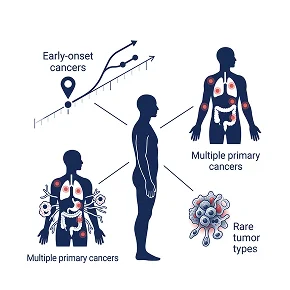
Personal history
- Early-onset cancers
- Multiple primary cancers
- Rare tumor types
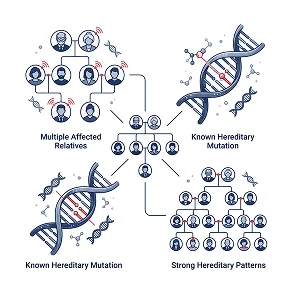
Family history
- Multiple affected relatives
- Known hereditary mutation
- Strong hereditary patterns
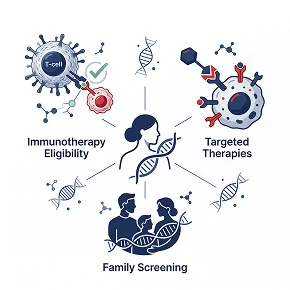
Treatment & screening
- Immunotherapy eligibility
- Targeted therapies
- Family screening
Oncology
Identify inherited risk that may influence treatment planning and ongoing management.
Surgery
Support hereditary risk assessment when surgical decisions may be influenced by inherited predisposition.
Preventive Care
Inform earlier screening and risk- management strategies for high-risk individuals.
Family Testing
Help identify hereditary risk that may have implications for relatives.
Clinical Insights
One test. Multiple clinical insights.
OncoRisk® distills complex hereditary data into decision-ready information for the entire care team.
01
Inherited Risk
Identify pathogenic and likely pathogenic variants with high-confidence reporting.
02
Variant Interpretation
Translate complex hereditary data into a clear clinical interpretation.
03
Prevention & Screening
Support risk-reduction and surveillance recommendations where appropriate.
04
Family Risk
Generate recommendations for at-risk kin and second-degree relatives.
05
Treatment Planning
Surface therapy eligibility signals for PARPi, immunotherapy, and targeted therapy.
06
Clinical Management
Align monitoring schedules and management pathways to established guidelines.
Clinical Impact
A positive germline result changes clinical management.
From finding to intervention: a transparent chain of clinical reasoning for every reported variant.
Report pathway
Finding to intervention.
A report connects an observed variant with its classification, clinical implication, and the next clinical action without presenting a specific patient result.
Example pathway
OncoRisk®
Finding
BRCA1 / BRCA2
pathogenic variant
Clinical implication
Elevated breast, ovarian,
prostate, pancreatic risk
Recommended action
Enhanced surveillance · PARPi eligibility · Cascade testing
Classification Framework
Three classifications. Three clinical pathways.
Every variant in an OncoRisk® report is triaged into a clearly defined action pathway.
Pathogenic / Likely Pathogenic
Clinical meaning
Sufficient evidence this is a disease-causing variant.
Recommended pathway
Alter management and initiate risk-reduction pathway.
Follow-up
Cascade testing for at-risk relatives.
Negative Results
Clinical meaning
Sufficient evidence that variant is not disease- causing.
Recommended pathway
Manage per standards of care and personal/family history.
Follow-up
No cascade testing required.
Variant of Uncertain Significance
Clinical meaning
Insufficient evidence for benign or pathogenic classification.
Recommended pathway
Do not use to limit action in other clinical management.
Follow-up
Periodic reinterpretation as evidence evolves.
Comparison
How OncoRisk® compares.
Set against widely used hereditary cancer panels, using published test documentation as the source.
| Feature | ONCORISK® | Other Hereditary Cancer Panels |
|---|---|---|
| Sequencing method | Whole exome sequencing plus MLPA | Targeted NGS panels only |
| Genes covered | ~20,000 protein-coding genes sequenced | 60 to 90 genes, panel dependent |
| Large CNV detection | Dedicated MLPA across 28 genes | Inferred from NGS read depth |
| Orthogonal confirmation | MLPA, inside the same workflow | Case-by-case, or specialized lab |
| Cancer types covered | 70+ cancer types, including rare cancers; 70+ syndromes | 10 cancer types in multi-gene panels |
| Guideline alignment | NCCN, ASCO and ESMO | NCCN / ACMG / CSO, varying |
| Turnaround time | 10–14 days | About 14 days to 3 weeks |
| Genetic counselling | Pre and post-test, certified counsellors included | Referral out, or available on request |
Decision Ready
Built for clinical decision making.
Engineered with and for oncologists, pathologists, and genetic counsellors who need signal, not noise.
- Clinical Evidence
- Family Recommendations
- Guidelines Alignment
- Variant Prioritization
- Genetic Counselling Support
Understanding Hereditary Risk
Clarity for clinicians and patients.
A shared vocabulary for hereditary cancer risk, grounded in evidence, framed for action.
For Clinicians
- Clinical interpretation
- Guideline alignment
- Variant prioritization
- Family recommendations
For Patients & Families
- Understanding inherited risk
- Screening implications
- Family testing
- Next steps
Ready When You Are
Test with confidence. Act with precision.
Empower clinical decisions with comprehensive hereditary cancer risk
profiling — engineered for oncology teams that lead.

Access Oncorisk One Test. Inherited Risk. Sample Reports & Case Studies
Fill in your details to explore real-world oncology insights…
Access Oncorisk One Test. Inherited Risk. Sample Reports & Case Studies
Fill in your details to explore real-world oncology insights…