









1Cell.Ai Named Best Healthtech Startup 2026
Recognised for Innovation in Precision Oncology & Patient Impact
Integrated NGS + IHC with WHO-aligned treatment guidance in 10–12 days.
Integrated NGS + IHC with WHO-aligned treatment guidance in 10–12 days.
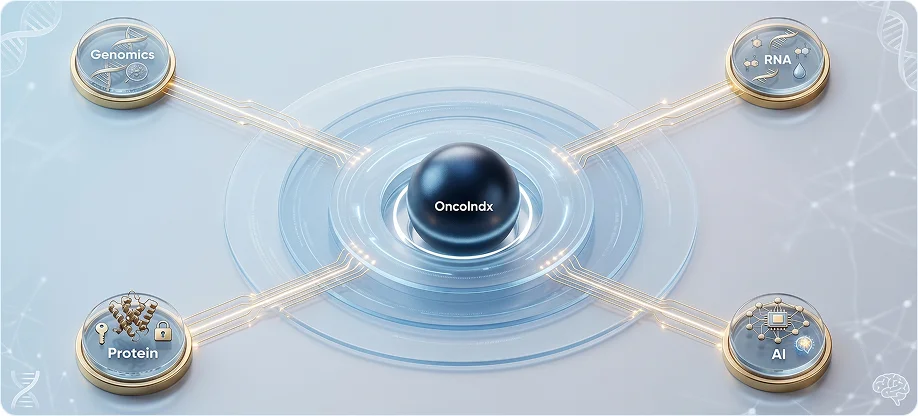
One integrated assay unifying DNA, RNA, and protein signals with AI interpretation — engineered for oncologists who need the complete biological picture before treatment.
Why Multi-Modal
Mutation calls answer what changed. Multi-modal profiling answers what’s actually driving the tumor and what will respond to therapy.
Three Biological Dimension
Genomics
Comprehensive detection of SNVs, indels, CNVs and structural variants across 1080+ oncology-relevant genes.
Clinical value
Identifies actionable variants and hereditary risk signatures.
Transcriptomics
Whole-transcriptome analysis capturing expression, alternative splicing and gene fusions.
Confirms functional impact and reveals fusion-driven therapy options.
Proteomics
Verifies eligibility for immunotherapy and antibody-drug conjugates.
Layered Intelligence
WHAT
Identify all genomic variants, mutations, and copy number changes across 1,080 genes
DRIVER
Determine which alterations are actively driving tumor biology through RNA expression analysis
WHY
What the Report Delivers
One report. Six clinical answers. Every recommendation traceable to the underlying molecular evidence.
Rev. 2025.1
F/54 · Lung adenocarcinoma · Stage IV
EGFR L858R · Sensitizing mutation
Confirmed expression at 4.2× baseline
8.4
mut/Mb
45%
TPS
Osimertinib first-line. Consider ctDNA monitoring at 8 weeks.
Matched trials
Tier-graded findings with evidence-level annotation.
On-label and off-label therapies mapped to biomarkers.
Regionally filtered, actively enrolling matches.
Known and emerging resistance markers surfaced.
TMB, MSI, PD-L1, HRD and pathway scores.
Contextual narrative with citation-backed rationale.
Platform Specifications
Cancer-relevant genes
Curated panel spanning solid tumors and hematologic malignancies.
Sequencing depth
Deep coverage for confident low- frequency variant calling.
Actionable biomarkers
IHC, expression and signature- based clinical markers.
Cancer types validated
Analytically and clinically validated across major indications.
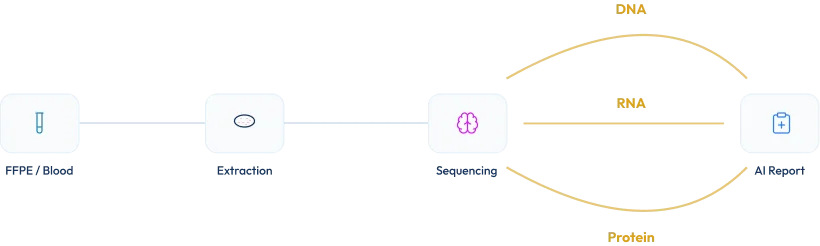
Assay workflow
Turnaround
Sensitivity
Sample
When to Deploy
Match the assay to the clinical question. Multi-modal isn’t always the answer — we’ll tell you when it is.
Case Study
How multi-modal profiling changed the treatment path when standard testing was inconclusive.
Clinical summary
Patient timeline
Biomarker findings
Amplified · 8.2×
BICC1-FGFR2 fusion
Stable
CPS 12
6.1 mut/Mb
Treatment outcome
Recommendation applied
Trastuzumab deruxtecan (T-DXd) with FGFR inhibitor trial enrollment — enabled only by combined DNA + RNA analysis.
ORR gain
PFS extension
Evidence
Product Comparison
Gene coverage
~50 genes
500+ genes
SNVs & indels
CNVs & structural variants
Trial & therapy matching
Why Choose OncoIndx
OncoIndx Multi-Modal is engineered around the questions oncology teams ask at the tumor board — not the biomarkers a technology happens to measure.
DNA, RNA, and protein signals interrogated from a single sample.
Interpretation trained on curated oncology cohorts and literature.
Every recommendation tier-graded and citation-backed.
Prioritized therapies and trials matched to your patient.
Empower confident treatment decisions with integrated multi-modal profiling — purpose-built for the oncologists making them.
Fill in your details to explore real-world oncology insights…
Fill in your details to explore real-world oncology insights…