
Imagine going to a tailor who doesn’t take a single measurement before making your outfit- instead handing everyone the exact same size off the rack and hoping it fits.
Seems absurd, right?
Yet for decades, this is exactly how we have treated cancer.
Two patients diagnosed with breast cancer traditionally receive the exact same chemotherapy, completely overlooking the fact that their tumors are biologically unique. The result?
One patient responds well, while the other endures severe side effects with zero benefit.
Historical data shows that only 20-30% of cancer patients benefit from traditional cytotoxic chemotherapy alone.
So much pain, years of research in medicine, and still..
Only 20-30%?
Cancer is not a single disease; it is hundreds of different cellular malfunctions sharing one name. In India, the stakes have never been higher.
The country recorded over 15.3 lakh new cancer cases in 2024, with 1 in 9 Indians expected to face a cancer diagnosis in their lifetime. Strikingly, 90% of cancer deaths are linked to metastasis (spread) and treatment resistance, rather than the primary tumor itself.
Treating every patient with a single blueprint is like using one key to open every lock.
Understanding Precision Oncology
What is Precision Oncology?
Precision oncology represents a total paradigm shift. Instead of treating a tumor based solely on where it is located in the body, it targets the specific genetic and molecular blueprint driving the disease.
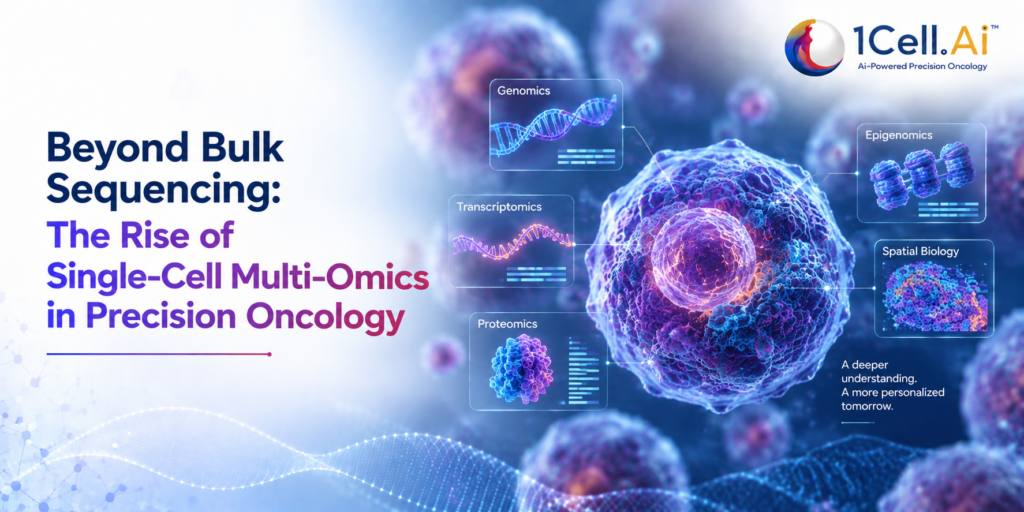
By utilizing advanced cellular analysis; including genomics (DNA), transcriptomics (RNA), and proteomics (proteins), oncologists can tailor therapies to match the patient’s exact tumor biology. This maximizes therapeutic efficacy while minimizing unnecessary toxicity.
Simply put: it delivers the right therapy to the right patient in the right dose at the exact right time.
The Turnaround: A clinical trial tracking over 13,000 patients revealed that individuals given targeted precision treatments achieved tumor shrinkage rates of 30.6%, compared to a meager 4.9% for those on blanket protocols. That is a 6x increase in treatment efficacy.
Why One-size-fits-all Treatment Falls Short:
Traditional oncology relies on generalized treatment protocols based on the tumor’s anatomical location such as chemotherapy, radiotherapy, etc. However, molecular profiling reveals that 66% of patients possess at least one actionable genomic alteration: a specific genetic flaw that can be targeted directly if discovered.
| Attribute | Traditional oncology | Precision oncology |
| Primary focus | Tumor location and size (e.g. lung, breast) | Molecular & genetic alterations |
| Strategy | Population-based generalized protocols | Patient-specific customized therapies |
| Trial error rate | High; relies on generic fall-back drugs | Low; guided by biological data |
| Toxicity profile | High systemic toxicity (chemo side effects). | Lower toxicity; spares healthy tissue. |
The Hidden Enemy: Tumor Complexity & Heterogeneity
Inter-Tumor vs. Intra-Tumor Variability
Here is something that surprises most people: No two cancers are the same. Even when the diagnosis is same.
Two individuals with lung cancer can have completely distinct genetic mutations driving their illnesses (inter-tumor variability).
Even more challenging is intra-tumor heterogeneity: different sections of the exact same tumor can carry entirely different mutations. One portion of a tumor might melt away under a specific drug, while another portion remains entirely resistant. This is one of the main reasons cancer is so difficult to treat.
A single tumor is not a uniform mass; it is a complex, continuously evolving ecosystem.
The Blind Spots of Traditional Biopsies
This complexity creates a real challenge for oncologists.
Traditional tissue biopsies are static pictures of a dynamic problem. They sample a single, tiny region of a tumor at one specific moment.
Biopsy cannot capture how a tumor changes over time, how it adapts to treatment, or when drug-resistant cells begin to multiply.
Making multi-month treatment decisions based on a single tissue sample is like diagnosing an elephant by looking exclusively at its trunk, it leaves clinicians with dangerously incomplete data.
The Power of Genomics & Biomarkers
Every cancer is born from genetic mutations- changes in a patient’s DNA. Genomic profiling reads these mutations across hundreds or thousands of genes simultaneously, giving oncologists a detailed map of what is driving a patient’s cancer.
Think of it as a forensic investigation of the tumor: finding the culprit genes that are telling the cancer cells to grow, divide and spread.
Biomarkers– measurable signals like genetic mutations or protein levels:- serve as the compass. For instance, identifying an EGFR mutation in a lung cancer patient unlocks access to specific, targeted therapies designed exclusively to disable that mutation, eliminating the need for broad-spectrum chemotherapy.
Liquid Biopsy: A Game-Changer for India
What is a Liquid Biopsy?
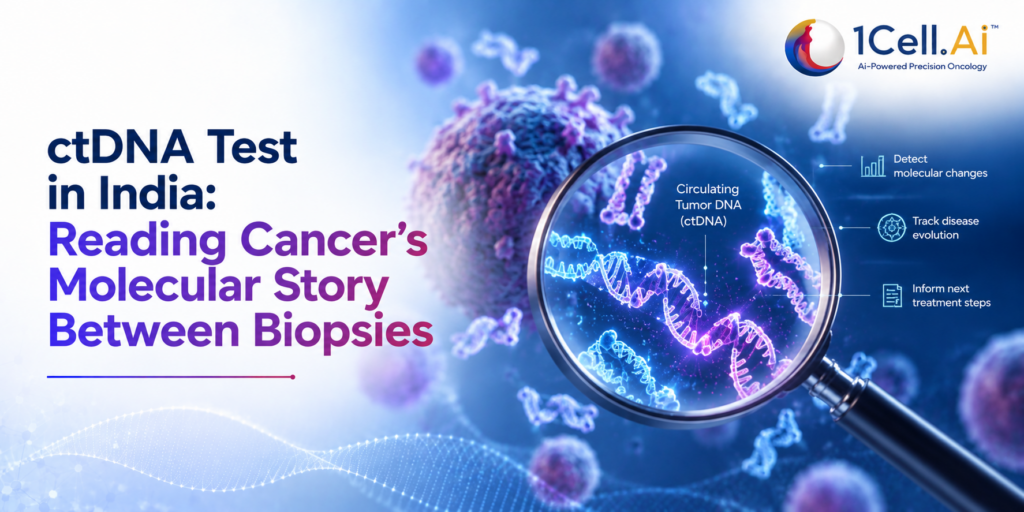
Surgically removing tumor tissue is invasive, painful, and often impossible if the tumor is hard to reach. A liquid biopsy bypasses this entirely by extracting tumor intelligence from a simple blood draw. It captures cell-free DNA (ctDNA) and Circulating Tumor Cells (CTCs) shed by tumors into the bloodstream.
Real-Time Monitoring and Macro Shifts
Liquid biopsies offer a comprehensive look at the entire body’s tumor burden rather than a single site. Real-world data indicates that ctDNA analysis successfully detects actionable mutations in 41.6% of advanced non-small cell lung cancer (NSCLC) patients who lack sufficient tissue for traditional testing.
The clinical landscape is shifting rapidly towards non-invasive methods:
- Blood-Based Testing: Blood samples now command a dominant 70.5% share of the sample collection market.
- Biomarker Dominance: Circulating tumor nucleic acids (ctNA) make up 48.0% of the global liquid biopsy volume, proving its vital role in selecting therapies and tracking resistance in real time.
AI-Driven Precision Oncology
The raw volume of genomic and clinical data generated by a single tumor is too massive for standard medical teams to process alone. Artificial Intelligence solves this bottleneck by reviewing millions of data points to predict treatment responses and surface structural patterns hidden from human eyes.
Transforming the Indian Clinical Landscape
AI is not here to replace oncologists; it is here to scale their impact. In India, where a single specialist often manages hundreds of patients simultaneously, AI acts as an advanced clinical copilot.
Major healthcare networks are leaning heavily into this trend: symbolized by initiatives like Apollo Cancer Centres launching India’s first dedicated AI-driven Precision Oncology Centre to rapidly build customized clinical regimens.
This technological push is backed by strong structural momentum. The Indian government has committed milestone-based funding of up to ₹1 crore for projects using AI in cancer screening alongside a nearly 10% increase in the central healthcare budget, accelerating the deployment of advanced diagnostics across regional hospitals.
How 1Cell.ai is Driving the Revolution?
At 1Cell.ai, we are bypassing traditional limitations by combining true single-cell multi-omics with specialized AI architecture. Our proprietary Cell Biopsy® technology isolates live Circulating Tumor Cells (CTCs) from a standard blood draw, analyzing their DNA, RNA, and protein structures simultaneously at single-cell resolution.
Here is how our ecosystem translates raw blood samples into highly personalized clinical roadmaps:
Step 1: Cell Biopsy® Isolation
A non-invasive blood draw captures live, circulating tumor cells directly from the patient’s bloodstream without the need for painful tissue surgery.
Step 2: Single-Cell Multi-Omics Profiling
The platform extracts and sequences DNA, RNA, and protein structures together, capturing the precise, real-time evolutionary profile of the tumor.
Step 3: 1Cell iCore Analytics Processing
Our AI infrastructure integrates these molecular datasets, runs predictive models, identifies active resistance mechanisms, and sifts through global treatment options.
Step 4: iCARE™ Console Action
The clinical insights are delivered as structured, actionable data directly to the oncologist’s dashboard, guiding targeted therapy selection and clinical trial matching.
Our Targeted Diagnostic Suite
-
OncoIndx®:
A comprehensive 1,080-gene Next-Generation Sequencing (NGS) profiling panel designed to analyze DNA, RNA, and protein biomarkers across 15+ solid tumor types.
-
OncoMonitor®:
A dual-biomarker liquid biopsy assay that combines ctDNA tracking with single-cell CTC-PD-L1 expression profiling to catch minimal residual disease (MRD) and early recurrence flags.
-
OncoTarget®:
An automated clinical matchmaker that aligns genomic variations with global therapeutic databases to surface custom targeted drug alternatives and available clinical trials.
Scaling Personal Healthcare Across India
The future of Indian cancer care hinges on making these technologies scalable. With cancer incidence in India expanding steadily year-over-year, precision medicine cannot remain exclusive to tier-1 corporate research centres.
By standardizing workflows to operate within local diagnostic spaces, 1Cell.ai has already served nearly 10,000 patients across India; demonstrating that advanced single-cell genomics can be deployed affordably from major metropolises to growing regional hubs.
On a global scale, international sequencing projects find highly actionable molecular targets in roughly 7 out of every 10 cancer patients tested. The science is ready, the infrastructure is scaling, and the era of treating cancer with generic tools is coming to a close.
Because every patient deserves a treatment plan as completely unique as their own DNA.