


Table of Contents
ToggleWhat Happens After Cancer Treatment?
The Problem With “All Clear”
There’s a moment every cancer patient waits for: the scan comes back clean, the surgeon says the margins are clear, and the oncologist says the words everyone has been hoping to hear:
“We don’t see any signs of disease.”
It’s a moment of relief.
But here’s the uncomfortable truth: “no evidence of disease” is not the same as “no disease.“
Imaging technologies like CT, PET, and MRI scans are powerful, but they have a resolution limit. A scan can only detect a tumors once it contains roughly a billion cells or more. Below that threshold, cancer can exist in the body completely invisibly, undetectable by any scan, any blood test, or any physical exam.
This is the detection gap: the space between “we can’t see it” and “it’s truly gone.” And it’s where recurrence quietly begins.
A substantial number of cancer patients who appear to be free of detectable metastasis will ultimately relapse into metastatic disease within 5 years of their initial tumor resection.
What is Minimal Residual Disease (MRD)?
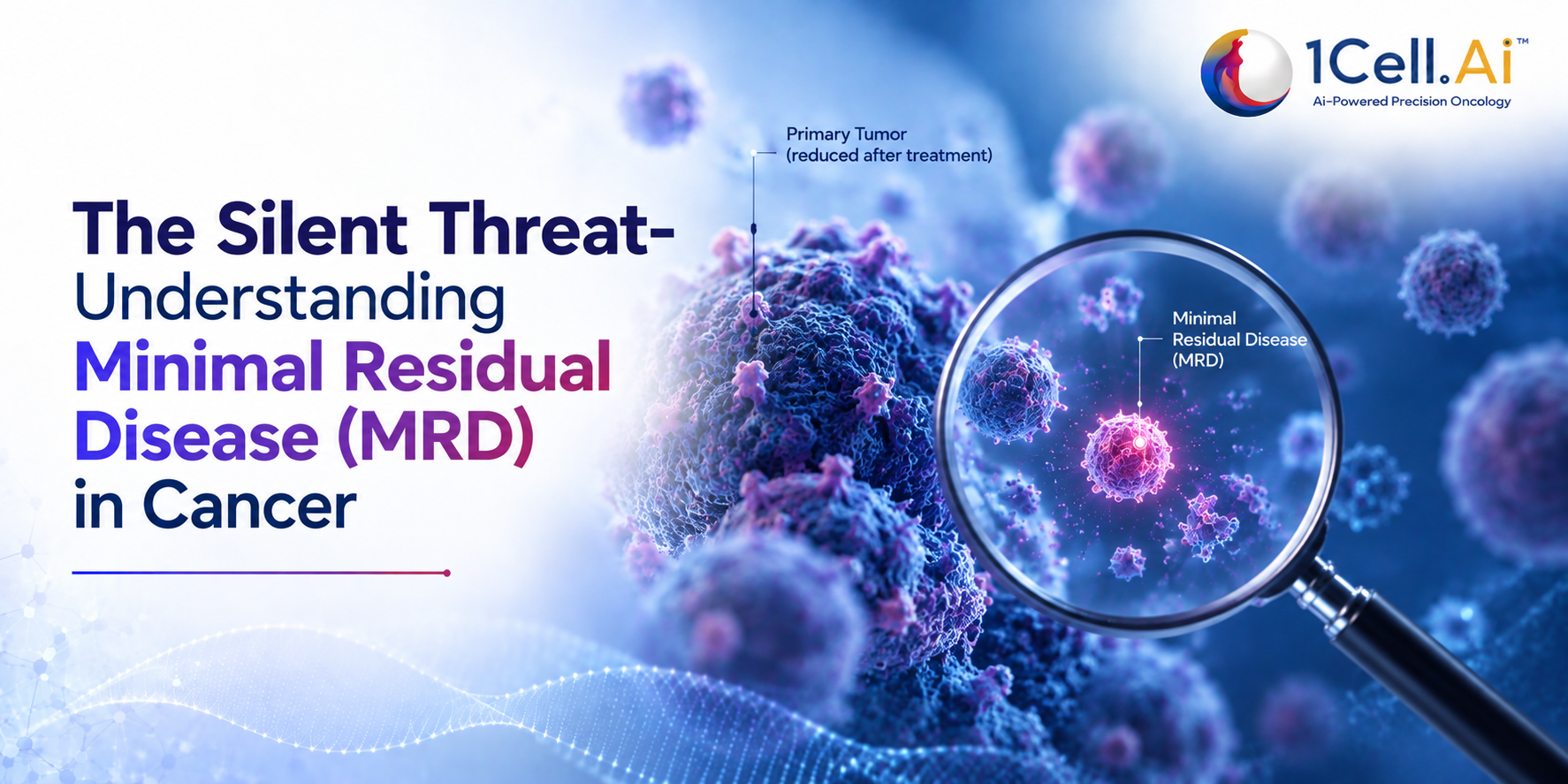
Minimal Residual Disease (MRD) refers to the small number of cancer cells or molecular traces of cancer that remain in a patient’s body after treatment, at levels too low to be picked up by conventional imaging or pathology.
Wait, MRD isn’t a new type of cancer.
It’s just the leftover of the original cancer. And whether or not it’s there determines, in large part, whether a patient stays cancer-free or relapses.
Why MRD Goes Undetected
The reason MRD goes undetected for so long is simple: the cells are there, but the tools to find them weren’t sensitive enough (until recently). For example, conventional 4- to 8-color flow cytometry can typically only detect aberrant cells with a sensitivity of 10-4 (finding 1 cancer cell among 10,000 normal cells)
But why are we so concerned about these hiding little cells? Well, recurrence is far more common than most people realize:
- Glioblastoma recurs in almost 100% of patients
- Epithelial ovarian cancer has a recurrence rate of around 85%
- Colon cancer recurs in roughly 33% of stage II/III patients
- Lung cancer recurrence ranges from 30-75%, depending on stage
- Even ER-positive breast cancer, considered relatively low-risk, sees recurrence in 5-9% of patients during and after maintenance therapy.
Overall, roughly 1 in 9 cancer survivors: about 11% will face a return of cancer at some point.
The Science of MRD Detection
ctDNA and Circulating Tumors Cells as MRD Markers
When tumor cells die or shed material into the bloodstream, they leave behind tiny fragments of DNA called circulating tumor DNA (ctDNA) and sometimes entire living cells, called Circulating Tumor Cells (CTCs). Both can be picked up from a simple blood draw, long before a scan would show anything.
The data on ctDNA’s predictive power is striking:
- In colorectal cancer, postoperative ctDNA detection is linked to a nearly 8-fold higher risk of disease progression (pooled hazard ratio of 7.95, 95% CI 5.30–11.91)
- In breast cancer, a plasma-only ctDNA assay detected residual disease in 85% of patients who later relapsed- up to 2 years before recurrence was clinically apparent, with a lead time of 3.4 to 18.5 months.
- Importantly, none of the recurrence-free patients in that same study showed any ctDNA at all – Meaning a clear MRD test is genuinely reassuring.
This is the core promise of MRD testing: it gives oncologists a molecular early-warning system, months before a scan would catch anything.
DNA Methylation: A New Frontier in MRD
While ctDNA mutation-based testing has been the dominant approach, it has one major limitation- it requires knowing exactly which mutations to look for, which often means sequencing the original tumor tissue first.
DNA methylation offers a different approach entirely.
Instead of hunting for specific mutations, methylation-based tests look at epigenetic patterns, chemical “tags” on DNA that differ systematically between healthy cells and cancer cells, across the entire genome. This means:
- No need for prior tumor tissue sequencing
- Detection works even when the tumors’ mutational profile is unknown or highly heterogeneous
- A single assay can theoretically work across multiple cancer types
It’s a genome-wide signal rather than a needle-in-a-haystack search for one or two mutations, which is part of why it’s emerging as one of the most exciting frontiers in MRD science. Recent multi-cancer early detection assays relying on whole-genome methylation have demonstrated specificities as high as 99.5% with extremely low false-positive rates (0.5%).
Why Sensitivity Matters at 0.001% Tumor Fraction
Here’s the part that’s easy to underestimate: sensitivity isn’t a “nice to have”; it’s everything in MRD testing.
A tumor fraction of 0.001% means that for every 100,000 fragments of DNA circulating in a patient’s blood, only one comes from cancer. Finding that one fragment is like finding a single specific grain of sand on a beach, and doing it reliably, reproducibly, across thousands of patients.
Why does this level of sensitivity matter clinically?
- The landmark testing strategy (a single ctDNA test at a fixed time point) has a pooled sensitivity of only 40%- meaning it misses 6 out of 10 patients with true residual disease.
- The surveillance strategy (repeated testing over time), dramatically improves sensitivity to 79%, while maintaining specificity of 98%.
In other words, a single test isn’t enough, and an insensitive test can give dangerously false reassurance. Ultra-sensitive, repeatable testing is what turns MRD from an interesting concept into a clinically useful tool.
MRD Across Cancer Types
MRD in Blood Cancers vs Solid Tumors
MRD testing actually has its roots in blood cancers: leukemias and lymphomas, where it has been used for decades to guide treatment intensity. Because blood cancer cells are, quite literally, already in the blood, detecting them is comparatively straightforward. In acute myeloid leukemia (AML) and multiple myeloma, bone marrow biopsies analyzed via Next-Generation Flow (NGF) cytometry or NGS are the gold standards, explicitly integrated into new response criteria guidelines.
Solid tumours(like lung, breast and colon cancer) are a different story. Cancer cells from a solid tumour have to actively shed into circulation, and they’re diluted across the entire bloodstream, making detection orders of magnitude harder. This is why solid tumors MRD testing has lagged behind blood cancer MRD by years, and why the recent advances in sensitivity are such a big deal.
MRD in Breast, Lung, and Colorectal Cancer
The clinical evidence is now substantial across major solid tumors:
| Cancer type | Key MRD finding |
| Breast cancer | A Plasma-only multiomic ctDNA assay detected ctDNA in 85% of patients within 2 years before recurrence . |
| Colorectal cancer | Postoperative ctDNA positivity associated with ~8x higher progression risk, with pooled hazard ratio of 7.95. |
| Colorectal liver metastasis | Approximately 50% of patients diagnosed with colorectal cancer develop colorectal cancer liver metastases. A population where MRD monitoring is critical. |
| Ovarian cancer | ctDNA positivity rate decreased to 25.8% in post-treatment landmark samples, indicating a significant reduction of ctDNA levels following effective treatment. |
| Cervical Cancer | 98.9% of patients were ctDNA-positive at baseline, dropping to 23-40% post-treatment depending on therapy. |
Post-Surgery Monitoring: Catching Recurrence Before It Happens
Let me bust a myth for you’ll:
Surgery is often described as “curative”; but the data tells a more nuanced story. In gynecologic cancers, 52% of patients who remained ctDNA-positive after surgery went on to experience recurrence.
That’s a coin-flip, and it’s information that, until recently, oncologists simply didn’t have access to.
This is the heart of MRD’s value: it transforms the post-surgical period from a “wait and watch” approach into an “watch and act” one.
AI and MRD – A Powerful Combination
How Machine Learning Improves MRD Detection
MRD testing generates enormous amounts of complex data: methylation patterns across millions of genomic positions, mutation signatures, fragment size distributions, and more. Making sense of this at the 0.001% sensitivity level isn’t something a human can do by eyeballing a spreadsheet. Artificial intelligence is stepping in to solve this. Machine learning models, such as deep neural networks utilized in Computational Flow Cytometry (CFC), can build detailed, automated reference maps of cell populations
Machine learning models trained on large reference cohorts of cancer and healthy samples can:
- Distinguish true tumor-derived signals from background biological “noise”
- Integrate multiple signal types (mutations + methylation + fragmentomics) into a single composite score
- Continuously improve as more data is added to training sets
Moving From Detection to Prediction
The next frontier isn’t just “is MRD present, yes or no?”
It’s “what does this specific MRD pattern tell us about how this patient’s cancer will behave?”
AI models can begin to answer questions like:
- Is this patient likely to progress in the next 3 months or the next 3 years?
- Is the residual disease likely to respond to the current therapy, or does it carry resistance signatures?
This shift: from binary detection to predictive risk stratification, is where MRD testing is heading next.
How 1Cell.ai is Tackling MRD
Introducing MIRAGE: Our ctDNA Methylation Algorithm
At 1Cell.ai, we built MIRAGE (Minimal Residual Assessment using Genome-wide Epigenomics)– our proprietary computational algorithm designed to detect MRD using genome-wide DNA methylation analysis, without requiring prior tumor sequencing.
MIRAGE evaluates methylated and unmethylated cytosines across differentially methylated regions throughout the genome, generating a composite methylation score that’s compared against a reference cohort of healthy individuals. In our validation study across 156 samples, MIRAGE achieved 96.8% specificity, and successfully detected ctDNA-positivity in 64% of clinical tumour samples, working at tumor fractions as low as 0.001%.
OncoMonitor® for Longitudinal MRD Tracking
A single MRD test is a snapshot.
OncoMonitor®, our dual-biomarker assay, is built for the surveillance approach; the strategy that data shows nearly doubles sensitivity compared to single-timepoint testing.
For the surveillance strategy, sensitivity was 0.79 and specificity was 0.98 . By combining ctDNA with CTC and PD-L1 profiling, OncoMonitor® tracks how a patient’s molecular disease status evolves over time; surgery, treatment, remission, and beyond, from repeatable blood draws.
What Early MRD Detection Means for Patients
For a patient, the practical difference is enormous.
Instead of a recurrence being discovered when it’s already large enough to cause symptoms or appear on a scan, MRD testing can flag it months in advance; while it’s still small, still localized in its molecular footprint, and still highly treatable.
It also means good news can be trusted more.
A clean MRD result: especially one repeated over time, offers a level of reassurance that imaging alone simply cannot provide.
The Future of MRD-Guided Cancer Care
Personalizing Treatment Based on MRD Status
MRD status is increasingly being used to answer one of oncology’s hardest questions: does this patient need more treatment, or can they safely stop?
- A patient who is MRD-negative after surgery may be a candidate for de-escalation: avoiding unnecessary chemotherapy and its side effects
- A patient who is MRD-positive may need escalation: additional adjuvant therapy, closer monitoring, or enrolment in a clinical trial designed specifically for MRD-positive patients
This is precision oncology in its most direct, actionable form; using a patient’s own molecular data to guide the single biggest decision of their post-treatment journey.
MRD as the New Standard in Oncology Follow-Up
As AI-driven multi-omic platforms become more scalable and accessible, MRD tracking is moving from the realm of clinical trials into routine diagnostic workflows. The continuous, real-time monitoring of tumor evolution via liquid biopsies is poised to replace the anxious waiting game of quarterly CT scans, cementing MRD status as the definitive standard for assessing true remission and guiding long-term cancer care.
Conclusion
“Cancer-free” is a phrase we all want to hear, but biology is rarely that absolute. Somewhere between a clean scan and true cure lies a molecular grey zone, where a handful of cells can determine a patient’s entire future.
Minimal Residual Disease testing exists to close that gap; turning an invisible risk into a measurable, trackable, actionable signal. At 1Cell.Ai, technologies like MIRAGE and OncoMonitor® represent our contribution to this shift, building the sensitivity, the science, and the AI needed to catch what was once impossible to see.
Because for cancer patients, the most powerful word isn’t “remission.” It’s “still clear”, confirmed not by hope, but by data.