
Table of Contents
ToggleHow knowing your risk, and watching for it at the molecular level- is changing what recurrence means for cancer patients.
There are two kinds of cancer stories:
The first kind ends at remission. Treatment finishes, scans clear, and life- cautiously, gratefully, resumes. These are the stories we celebrate. The ones shared at awareness walks and written in hospital newsletters.
The second kind is quieter. It begins with a follow-up scan that looks different from the last one. A tumor marker that climbed. A symptom that didn’t exist six months ago. The moment an oncologist has to say the words no survivor ever stops dreading: “It’s come back.”
What separates these two stories is not always biology.
Sometimes it is surveillance. Sometimes it is the difference between watching and truly watching; between a scan every six months and a molecular early-warning system that never stops listening.
That difference is what this piece is about.
The Recurrence Reality Nobody Talks About Enough
Cancer recurrence is not rare. It is, in fact, the defining challenge of cancer survivorship, and the numbers are sobering:
- Ovarian cancer recurs in approximately 85% of patients
- Glioblastoma recurs in nearly 100% of cases
- Colorectal cancer recurs in roughly 1 in 3 stage II/III patients
- ER-positive breast cancer carries a recurrence risk that extends well beyond five years- with late recurrence documented even at 10-15 years post-diagnosis
- Lung cancer recurrence ranges from 30-75% depending on stage
And yet, the standard post-treatment surveillance most patients receive- imaging every few months, tumor marker blood tests, physical examinations, was designed in an era before molecular monitoring existed. It detects recurrence when it has already grown large enough to be visible. Not at its earliest, most treatable molecular moment.
“The question isn’t whether we can do better. The question is whether we are.”
Two Points in Time Where We Can Change the Outcome
Modern precision oncology is identifying two distinct windows where intervention can genuinely alter the trajectory of cancer for a patient and both are earlier than most people realize.
- Window 1: Before cancer develops, or before it progresses
Not every patient arrives at the oncologist’s door equal in their risk. Some carry germline mutations- inherited genetic changes that significantly elevate their lifetime cancer risk. Some have had prior cancers, with tissues and cells that carry molecular signatures of future vulnerability. Some have family histories that imaging-based screening was simply never equipped to adequately address.
This is where risk stratification begins, and where understanding a patient’s molecular risk profile can inform not just surveillance intensity, but preventive strategies, genetic counselling referrals, and early detection protocols that imaging alone would never trigger.
- Window 2: After treatment- before recurrence becomes clinical
Once treatment is complete, the question shifts:
Is cancer truly gone, or is it hiding?
Circulating tumors DNA (ctDNA)– fragments of cancer genetic material shed by tumor cells into the bloodstream, can be detected at concentrations as low as 0.001% tumor fraction. At this sensitivity, molecular traces of disease can be identified months before a scan would show anything, and in breast cancer specifically, studies have demonstrated ctDNA detection up to 18.5 months before clinical recurrence becomes apparent.
These two windows: risk before cancer and molecular evidence after treatment, are not separate conversations. They are two points in the same continuum of care. And they require tools designed specifically to address them.
What Happens Between “Cancer-Free” and “It’s Back”:-
To understand why surveillance matters so much, it helps to understand what actually happens during the period most patients think of as remission.
Surgery removes the tumor. → Chemotherapy kills the rapidly dividing cells. → Radiation targets a defined field.
But cancer is not one homogeneous mass of identical cells; it is a dynamic, heterogeneous population, constantly evolving.
Some cells survive treatment. Not because the treatment failed; but because cancer, at the cellular level, is extraordinarily good at adaptation. Resistant subclones– small populations of tumor cells that carry mutations conferring treatment resistance- can persist in the body at levels too low for any imaging to detect. They lie dormant. They divide slowly. They wait.
This is Minimal Residual Disease (MRD) – and it is the biological mechanism behind most cancer recurrences.
The tragedy of conventional surveillance is not that it doesn’t work. It is that it doesn’t start working until MRD has grown from a handful of invisible cells into a detectable mass. By that point, the optimal intervention window has often already passed.
The Science of Catching What Scans Miss
The shift happening in oncology right now is from detection to prediction, from finding recurrence to anticipating it.
This shift is powered by three technologies working together:
- ctDNA Analysis examines fragments of tumor-derived DNA circulating in the bloodstream. Because these fragments carry the specific mutations of the patient’s cancer, they can be distinguished from normal cell-free DNA with high specificity, and their presence or absence in serial blood draws tells a powerful molecular story about disease status over time.
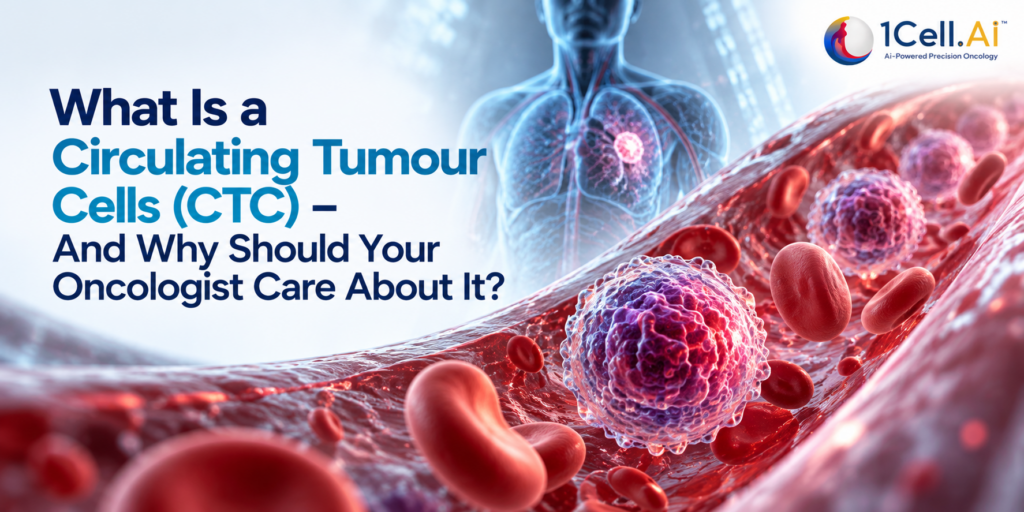
- Circulating Tumor Cell (CTC) Profiling goes further- capturing and analyzing entire live tumour cells that have shed from the primary tumour or metastatic sites into the blood. CTCs carry not just DNA, but RNA and protein information- providing a multi-dimensional view of tumor biology that ctDNA alone cannot deliver. Their presence, their count, their molecular characteristics, and particularly their PD-L1 expression reveal whether the immune system is being actively evaded, and how aggressively disease may be progressing.
- DNA Methylation Analysis is the newest and perhaps most sensitive frontier. Rather than hunting for specific known mutations, methylation-based MRD detection looks at genome-wide epigenetic patterns- chemical “tags” on DNA that differ systematically between cancer cells and healthy cells, allowing detection even when the tumor’s mutational profile is unknown or highly heterogeneous.
Together, these three approaches create a molecular surveillance system that works continuously between the scans- watching, measuring, and flagging change at its earliest possible signal.
How 1Cell.Ai Is Building the Full Continuum
At 1Cell.ai, we have built our platform around both surveillance windows:- risk before cancer, and molecular monitoring after treatment, because we believe the oncology journey should be protected at every stage, not just at diagnosis.
1. OncoRisk– Knowing Before Cancer Strikes
OncoRisk is our risk assessment and early detection platform- designed for patients at elevated cancer risk due to hereditary factors, prior cancer history, or family history patterns that warrant proactive, molecularly-guided surveillance.
Rather than waiting for a cancer to become visible on imaging, OncoRisk uses genomic profiling to identify patients who carry the highest risk- so that surveillance can be intensified, preventive interventions can be initiated, and early detection has the best possible chance of intervening before the disease progresses.
For the patient with a strong family history of breast cancer who tests negative for BRCA1/2 but carries other high-risk variants- OncoRisk provides the complete molecular risk picture that single-gene testing misses. For the colorectal cancer survivor whose family history suggests hereditary risk- OncoRisk identifies whether ongoing molecular surveillance should be escalated.
The goal is simple: catch it before it starts, or catch it before it progresses.
2. OncoMonitor® – Watching Between the Scans
OncoMonitor® is our dual-biomarker longitudinal monitoring platform- combining ctDNA profiling with CTC enumeration and PD-L1 expression analysis from a single blood draw.
Where OncoRisk identifies who is at risk, OncoMonitor® is the ongoing vigilance system that watches what happens next- tracking disease status from remission through the entirety of the survivorship journey, at a molecular level that no imaging schedule can match.
In a landmark study of 265 late-stage lung cancer patients using our OncoMonitor® dual-biomarker approach, we demonstrated something critical: 25.66% of patients who were ctDNA-negative – and would have been classified as low-risk by standard liquid biopsy:- were CTC-positive. These were patients whose disease activity would have gone entirely undetected by ctDNA monitoring alone.
This is the fundamental insight behind OncoMonitor®: one biomarker is not enough. The dual approach- ctDNA and CTC catches what each misses individually, and together they deliver a level of surveillance sensitivity that serial imaging simply cannot approach.
3. MIRAGE- The Deepest Look Available
For patients where the highest sensitivity is needed; post-surgery, post-chemotherapy, in cancers with known high recurrence risk- our MIRAGE algorithm (Minimal Residual Assessment using Genome-wide Epigenomics) takes molecular monitoring to its most sensitive level.
MIRAGE analyses genome-wide DNA methylation patterns, detecting tumor-specific epigenetic signals at tumor fractions as low as 0.001% – without requiring prior knowledge of the tumor’s mutational profile. Validated across 156 samples with 96.8% specificity, MIRAGE can identify residual disease in patients who appear cancer-free by every conventional measure.
For the patient six months post-surgery who wants to know, with the highest possible confidence, whether the disease has truly gone- MIRAGE is the closest thing to a definitive molecular answer that currently exists.
What “Ready” Actually Looks Like
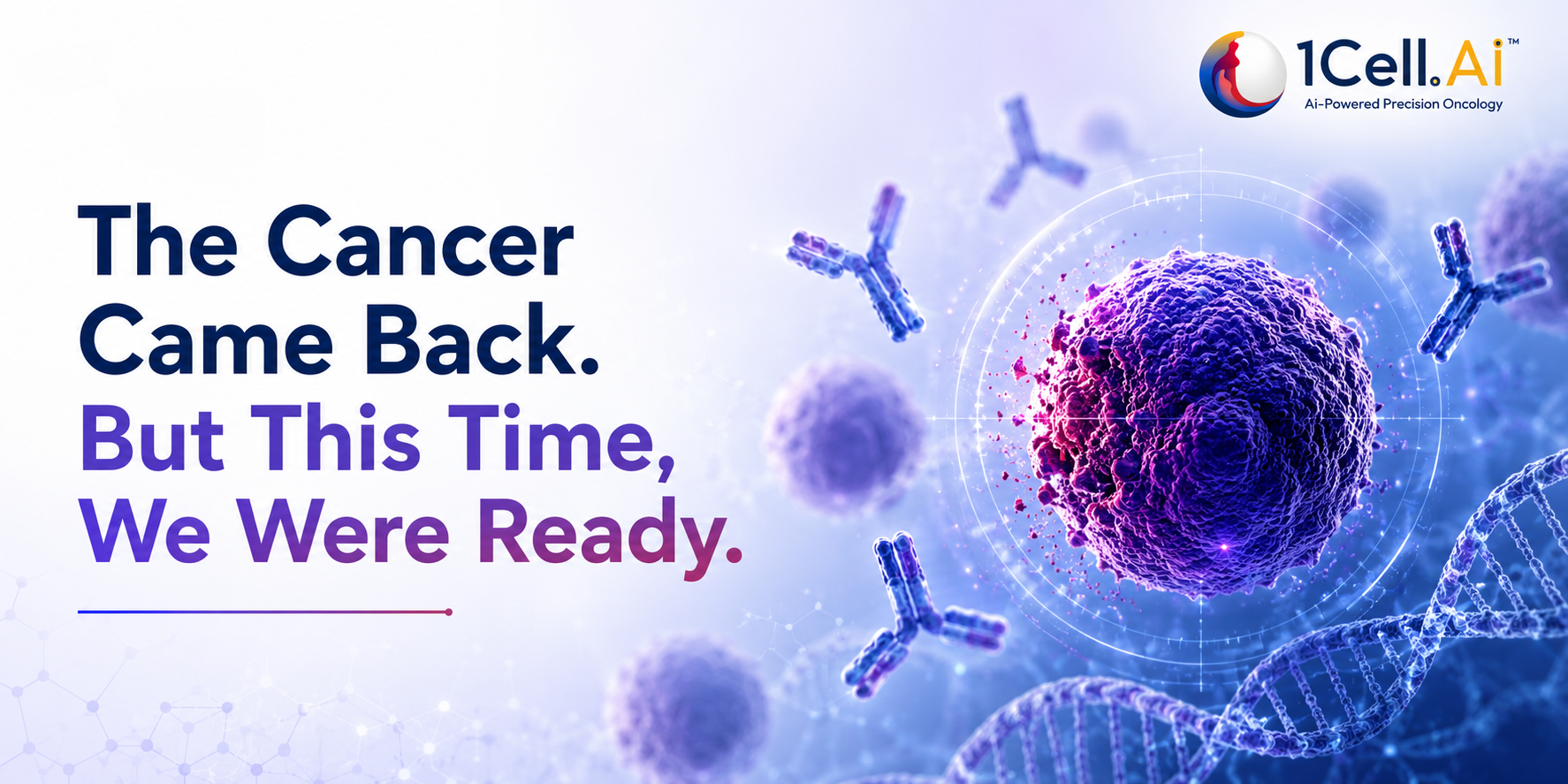
The title of this piece: The Cancer Came Back; But This Time, We Were Ready, is not about preventing recurrence through willpower or positive thinking. It is about something more concrete and more powerful:
Knowing your risk before cancer develops. Monitoring at the molecular level after treatment. Acting on the signal before it becomes a scan result.
A patient on OncoRisk knows whether their molecular risk profile warrants intensified surveillance before they ever receive a cancer diagnosis. A patient on OncoMonitor® has a molecular early-warning system running between every scheduled scan- one that can detect change up to 18 months before imaging would. A patient whose post-surgical monitoring includes MIRAGE has the most sensitive residual disease assessment currently available.
This is not the cancer care of five years ago. This is what “ready” looks like now.
The Conversation Worth Having
If you are a cancer survivor or a patient at elevated risk- here are the three questions worth raising with your oncologist at your next appointment:
- “Based on my cancer type, stage, and family history, should I be on a molecular risk stratification programmed like OncoRisk?”
- “Is ctDNA and CTC-based MRD monitoring appropriate for my post-treatment surveillance?”
- “What is my plan if my molecular markers change between scans; before imaging shows anything?”
The answers to these questions may not change your treatment plan today. But they may change what tomorrow looks like and for cancer survivors, that is everything.
At 1Cell.Ai, OncoRisk, OncoMonitor®, and MIRAGE form an integrated continuum of molecular surveillance- from identifying who is at risk, to watching for the earliest signs of disease return, to detecting residual cancer at the deepest molecular level currently available.
To learn more, visit 1cell.ai or write to us at [email protected]