

Table of Contents
ToggleThere are cancer cells travelling through your blood right now. No, really. Here’s what that means – and why it’s actually good news.
Let me say something that sounds alarming but is actually the opposite of alarming.
If you have cancer, or have had cancer – there is a very real chance that individual tumour cells have broken away from the original tumour and entered your bloodstream. They are called Circulating Tumour Cells – CTCs, and they have been quietly making their way through your body, carried along with your red blood cells, your white blood cells, and your platelets.
Still with me? Good.
Because here is the part that changes the story entirely:
We can now find them. Analyse them. And use them to understand your cancer in ways that were simply impossible a decade ago.
So What Exactly Is a CTC?
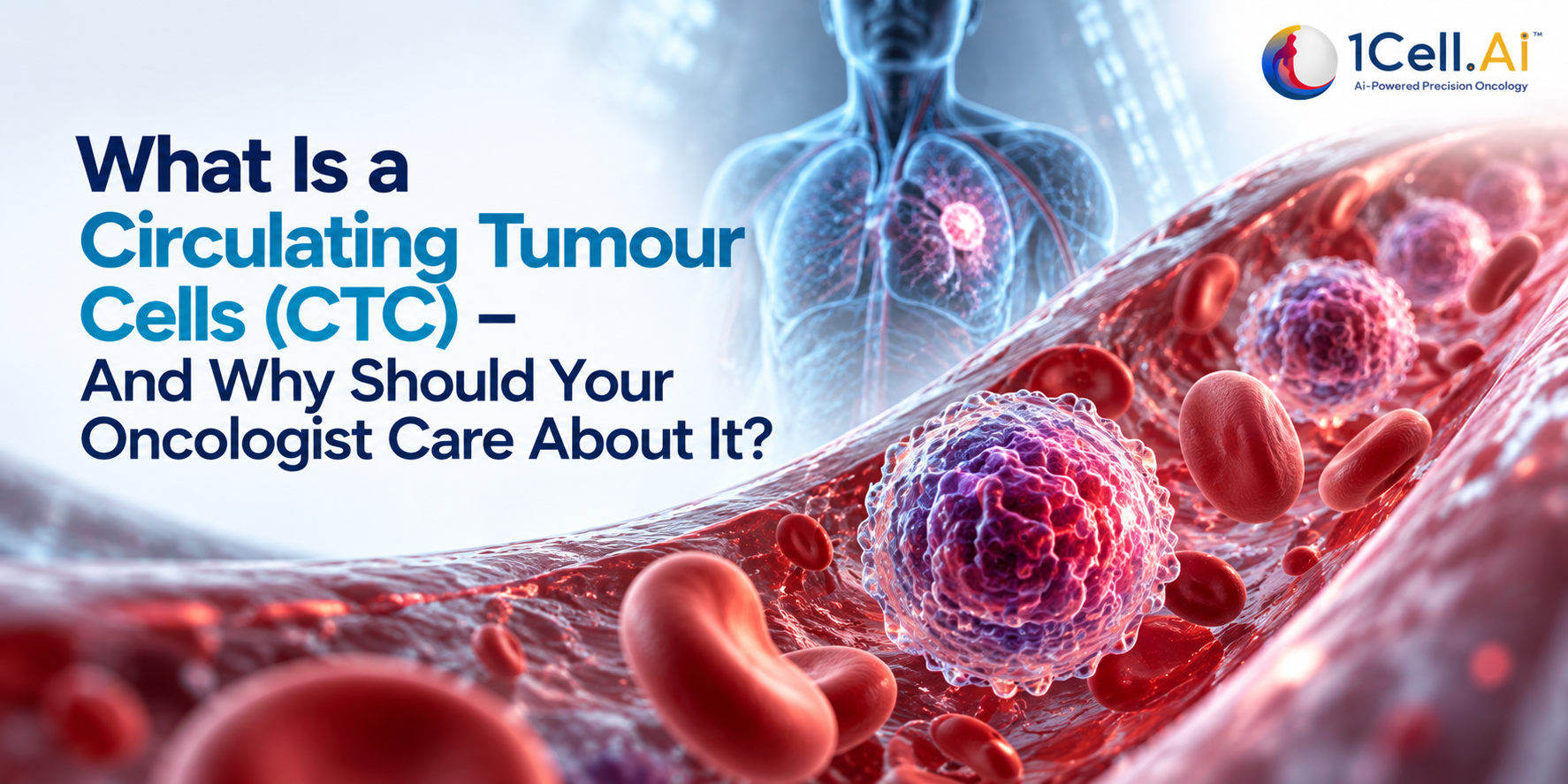
A Circulating Tumour Cell is exactly what it sounds like- a cancer cell that has detached from a tumour (either the primary tumour or a metastatic site) and entered the bloodstream.
Think of it like this. A tumour is a city. Most of the population stays put- living, dividing, causing local damage. But some cells break off and travel. They get into the bloodstream like passengers boarding a train- circulating through the body, occasionally settling somewhere new, and sometimes seeding what oncologists call metastasis.
CTCs are those passengers. And for a long time, we had no way to intercept them.
The challenge is staggering in scale.
In a typical blood sample, you might find 1 to 10 CTCs among 5 to 10 billion red blood cells and 10 million white blood cells. Finding a CTC in blood is not like finding a needle in a haystack. It is like finding one very specific grain of sand on a very large beach; while the tide is coming in.
Just a fancy way of saying it’s humanly impossible to find.
Why Haven’t I Heard of This Before?
Honestly? Because until recently, the technology to reliably find, capture, and analyse CTCs simply did not exist at the sensitivity needed to be clinically useful.
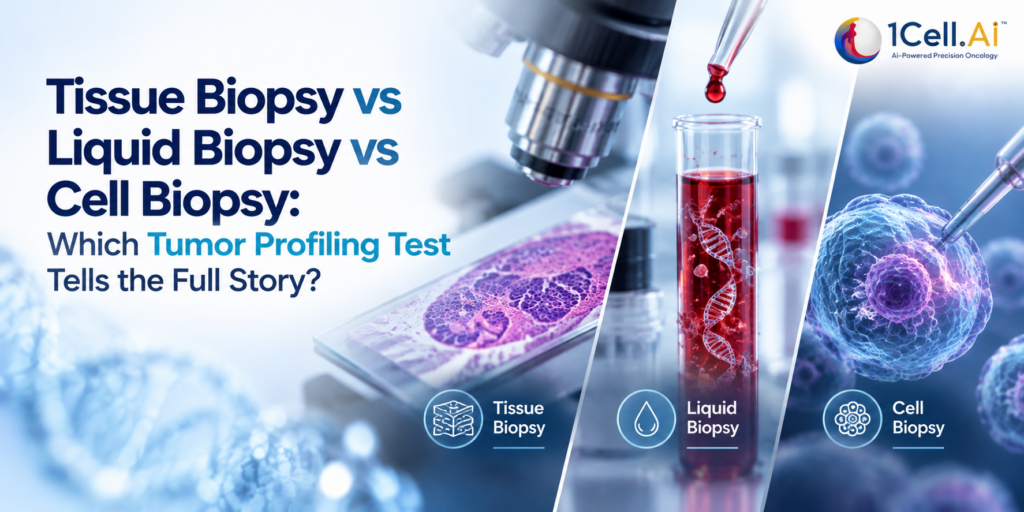
Standard cancer diagnostics have relied on tissue biopsies- physically removing a piece of the tumour to examine it in a laboratory. This is valuable but has obvious limitations.
You cannot biopsy a patient every few weeks to track how their cancer is evolving. You cannot biopsy a tumour that is too small to see, too deep to reach, or too dangerous to access. And a biopsy captures one region of the tumour, not the whole picture.
And let’s just be honest, it’s painful at the end of the day.
CTCs changed the equation. Because they circulate in blood, they can be accessed through something patients are very familiar with: a blood draw.
No procedure. No anaesthesia. No recovery time.
What Can a CTC Tell Us That a Tissue Biopsy Can’t?
Quite a lot, actually. And this is where it gets genuinely exciting.
A tissue biopsy captures a single snapshot of a single region of the tumour at a single point in time. A CTC captured from blood reflects what is happening in real time, and because it is a live cell, not just a fragment of DNA, it carries the full biological complexity of the tumour.
At 1Cell.Ai, our OncoIncytes™ platform analyses individual CTCs for three layers of biological information simultaneously:
- DNA – the mutations driving the cancer, resistance mechanisms, and pharmacogenomic markers that affect how the patient processes chemotherapy
- RNA – which genes are actually switched on right now, including fusions and expression patterns that DNA alone cannot reveal
- Protein – what is sitting on the surface of the cell that could be targeted by therapy, including HER2, PD-L1, TROP-2, and other markers that determine eligibility for some of the newest and most promising cancer treatments available today
Getting all three of these from a tissue biopsy requires multiple tests, significant tissue consumption, and often multiple procedures. Getting all three from a CTC requires a blood draw.
Just a blood draw.
Why Should My Oncologist Care?
Because CTCs tell a story that other tests cannot.
➕They reveal tumour heterogeneity. Your tumour is not one uniform mass of identical cells. Different regions carry different mutations; and some of those mutations may be driving resistance to the treatment your oncologist has chosen. CTCs from different subpopulations of the tumour can reveal this complexity in ways that a single tissue biopsy, by definition, cannot.
➕They track what happens between scans. Your quarterly CT scan tells your oncologist what the tumour looks like at that moment. CTC monitoring from serial blood draws tells them what is happening in the weeks and months in between, catching early signs of progression or resistance before they are visible on imaging.
➕They identify who will benefit from the newest therapies. Antibody-Drug Conjugates – one of the most exciting classes of cancer treatment today, work by targeting specific proteins on the surface of cancer cells. Knowing whether those proteins are expressed, and at what level, is critical for deciding whether these treatments will work. CTCs, profiled for protein expression directly from blood, answer that question in real time.
➕They monitor minimal residual disease. After surgery or treatment, when scans look clear and tumour markers are normal, CTCs can detect microscopic evidence of remaining disease, the cells that survived treatment and may be the seeds of future recurrence. For patients who want the most complete reassurance that their surveillance is working, CTC monitoring adds a layer that imaging alone simply cannot.
A liquid biopsy test india That Goes Beyond ctDNA
Most people who have heard of liquid biopsy associate it with ctDNA- circulating tumour DNA, fragments of genetic material shed by tumour cells into the bloodstream. ctDNA testing has been a genuine revolution in cancer care.
But ctDNA is DNA from dead or dying cells. CTCs are the live ones. And dead men tell no tales.
And live cells carry information that dead cell fragments cannot – protein expression, RNA activity, and the biological state of a tumour that is actively growing, dividing, and potentially evolving resistance to treatment.
This is why a liquid biopsy test india that integrates both ctDNA and live CTC analysis delivers a more complete picture than either modality alone. In our ASCO 2026 research on pancreatic cancer patients, 65% of genomic alterations were found exclusively in CTC-DNA- completely invisible to matched ctDNA testing.
Sixty-five percent!!!!
That is not a marginal improvement. That is the difference between finding the answer and missing it entirely.
The Bottom Line for Patients
If you are navigating a cancer diagnosis, or monitoring for recurrence after treatment- here are the questions worth raising with your oncologist:
- “Has my tumour been profiled using comprehensive genomic profiling, and does that include CTC analysis?”
- “Is CTC-based monitoring an option for my surveillance plan?”
- “Are there targeted therapies or ADCs I might be eligible for that require protein expression data from my tumour cells?”
You do not need to walk in with a textbook. You just need to walk in knowing that a blood draw can now tell your oncologist things that were previously only accessible through surgery.
That is not a small thing.