

Table of Contents
ToggleIndia is expected to become a developed country by 2047. But as we move towards that future, our disease patterns are also shifting – from infectious diseases to non-communicable ones.
Diabetes, HTN, and cancer are no longer diseases of the upper class. In 2022, it was estimated that every 1 in 9 Indians would develop cancer during their lifetime- translating to roughly 1.46 million new cases. By 2024, this figure escalated to 1.56 million incident cases and 874,404 cancer-related deaths.
Globally, cancer mortality is projected to increase by nearly 75% by 2050.
The obvious question then is; if healthcare is improving, why are cancer cases and deaths still rising? The answer lies in a paradox. Healthcare has improved and increased life expectancy, but a longer lifespan also means a larger elderly population, one that is naturally more vulnerable to cancer. Even if incidence rates remain stable, the absolute number of cases will continue to rise.
But longevity isn’t the only factor. Lifestyle changes are silently accelerating this trend. Tobacco use, sedentary habits, and ultra-processed diets are driving cancers such as oral, lung, and gastrointestinal malignancies. Alongside this, environmental exposure, especially PM2.5 and indoor air pollution acts as a major catalyst, particularly for lung cancer.
| Demographic group | Most prevalent cancer sites | Key Epidemiological statistics (2022-24) |
| Females | Breast, cervix uteri, Ovary, Corpus uteri, lung. | Breast cancer lead at 28.8%, followed by cervical (10.6%), and ovarian (6.2%). |
| Males | Lung, oral cavity, prostate, Oesophagus, stomach | Tobacco user drives over 58.8% of male cancer sites. |
| Regional extremes | Varies by geography. | Mizoram reports lifetime risks of 21.1% in males and 18.9% in females. |
Cancer Diagnosis Challenges in India
India is now the most populous country, with nearly 1.4 billion people. While statistics suggest that we meet the ideal doctor-to-population ratio, the reality is more complex. These numbers include AYUSH practitioners; if we consider only allopathic doctors, the ratio drops closer to 1:1200.
Infrastructure reflects a similar gap. India has around 1.6 hospital beds per 1000 population, whereas developed countries maintain 3-4 beds per 1000. Public health expenditure also remains low at 1.5-2% of GDP, compared to a global average of 6-7%.
So, the gap is real and it directly impacts cancer care.
Late Detection & Limited Access
India has lot of geographical variation. India’s healthcare indicators seem adequate overall, but they hide a stark rural–urban divide, with overserved urban areas and underserved rural regions.
In short, the better are becoming best. But the worse is becoming worst.
But shouldn’t we be focusing more on rural areas if 77.45 percent of cancer patients originate from rural areas? Rural patients face significantly higher rates of advanced-stage presentation (56.1 percent versus 47.7 percent for urban counterparts) due to multiple referrals, misdiagnoses at underequipped primary care centres, and the catastrophic economic burden of traveling to urban hubs.
Time is medication in cancer.
The truth of the matter is an estimated 60 percent of breast cancer patients in India are identified only at Stage III or Stage IV. When situation is out of our hands. When the cancer has done irreversible damage to the body of a patient.
This late-stage presentation severely truncates survival probabilities.
Limits of Traditional Biopsy
The concept of tissue biopsy evolved in the mid-19th century following Rudolf Virchow’s work on cellular pathology (1858). With the advancement of microscopy and histological staining, biopsy became the gold standard for cancer diagnosis by the early 20th century.
It has helped us a lot!
But as we are moving forward, it’s time to move on and look on its limitations and work onto it.
The problem with tissue biopsy is, we can’t reach the inaccessible parts of the body like pancreas, retroperitoneum, brain stem, etc.
Even if we access it, there are chances of haemorrhage, pneumothorax, and prolonged recovery times that may delay the initiation of systemic therapy. Tissue biopsy is invasive, highly resource intensive and painful.
And this painful procedure is often repeated. Why?
Tissue biopsies are frequently non-diagnostic due to insufficient cellular yield or extensive necrosis within the sampled area. Meta-analyses indicate pooled non-diagnostic rates of up to 4.4 percent in malignant lesions and 10.4 percent in benign lesions.
Need for Faster, Accurate Diagnosis
In a country where most people present at late-stage and the gold standard is causing more harm than good, there is an urgent life-or-death imperative for faster, more accurate, and less invasive diagnostic modalities in India.
Medical reports from 2025 demonstrate that over 56.1 percent of Indian cancer patients experience diagnostic delays of 4 to 6 months from the onset of symptoms, while 19.1 percent face delays exceeding 6 months.
Cancer is like a time bomb, and we are just sitting in front of the countdown for months and doing nothing.
In India patients often try 1000s things before visiting an actual doctor. Home remedies, consult online, visit quacks, to name a few. This phenomenon of trying alternative medicine before allopathy is noticed in nearly 27.5 percent of the patient population, which escalates the rate of advanced-stage presentation to nearly 89.67 percent within that specific cohort.
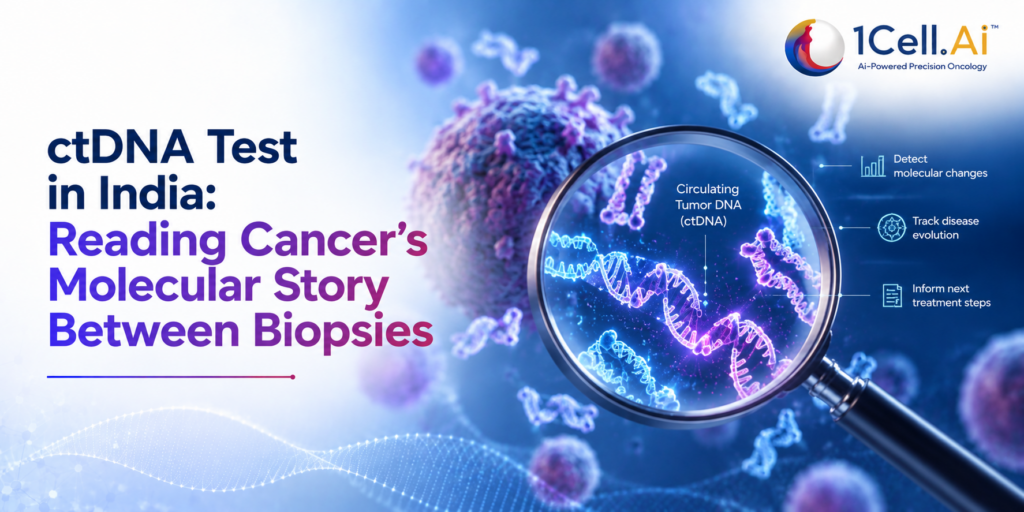
This is where newer approaches like liquid biopsy are gaining importance. Instead of invasive tissue sampling, liquid biopsy analyses circulating tumour components from blood. It is faster, minimally invasive, and provides a more comprehensive view of tumour biology.
For example, in advanced lung cancer, the turnaround time for liquid biopsy is around 9.6 days, compared to over 36 days for traditional tissue biopsy. This difference alone can significantly impact treatment timelines and outcomes.
What is AI in Cancer Diagnosis?
Medical knowledge has always been vast. That is one of the reasons why doctors are valued so much. In the 1950s, the medical knowledge used to get doubled every 50 years. Now, in the 2020s, it doubles every 73 days.
To expect from a normal human to remember, apply and cope up with this humongous amount of data is inhuman.
AI must come in the picture of cancer diagnosis to process the vast, multidimensional, and highly complex data generated by modern oncology, ranging from digitized histological whole-slide images to terabytes of genomic sequencing data per patient.
How AI Works in Oncology?
Artificial intelligence in oncology relies on the deployment of advanced subsets of machine learning (ML) and deep learning (DL). Unlike early rule-based expert systems developed in previous decades (such as MYCIN), which were constrained by rigid, manually programmed “if-then” logic, modern DL architectures utilize artificial neural networks featuring multiple hidden layers. These systems can detect subtle abnormalities that may not be visible to the human eye, making them extremely valuable in early detection and diagnosis.
More recently, we are seeing the emergence of agentic AI systems that can integrate multiple data sources, compare findings with current research, and even assist in suggesting treatment pathways – all while keeping the clinician in control.
AI vs Traditional Diagnosis
|
|
|
|||||||||
| Diagnostic Accuracy (General) |
|
|
|||||||||
| Turnaround Time (TAT) | 30 – 45 minutes per standard report | 10 -15 minutes per report | |||||||||
| Inter-observer Variability
|
High (Subjective visual interpretation)
|
Negligible (Standardized mathematical algorithms) | |||||||||
| Workload / Burnout Risk | Extremely high due to cognitive fatigue | Significant reduction (OR 1.77 for burnout reduction) |
Role of Genomics & Data
The clinical efficacy and generalizability of any AI model are inextricably tethered to the quality, genetic diversity, and volume of the data it consumes during its training phase. Historically, the AI models and genomic diagnostic panels deployed in India have been trained predominantly on datasets derived from Western, Caucasian populations. This led to degraded predictive accuracy, high false-negative rates, and severe algorithmic bias when applied to South Asian demographics.
To eliminate global disparities in precision oncology, the Indian Cancer Genome Atlas (ICGA) Foundation successfully launched India’s first comprehensive, indigenous multi-omics data portal in late 2024, with massive expansion initiatives continuing through 2025 and 2026.
All biospecimens are derived from treatment-naïve Indian patients, ensuring pristine baseline genomic data free from therapy-induced mutational noise.
In July 2025, the ICGA implemented a rigorous, updated Data Policy (Version 3.0), meticulously aligned with India’s Digital Personal Data Protection (DPDP) Act of 2023. This policy ensures ethical, privacy-preserving, yet democratized open access for global and domestic researchers, leveraging tiered access governance and FAIR (Findable, Accessible, Interoperable, and Reusable) principles.
Key Applications of AI in Oncology
AI has pierced its roots into every aspect of oncology. It has moved out of the labs into the real commercial world. Thanks to progressive government regulatory initiatives, national funding paradigms, and a fiercely innovative health-tech startup ecosystem. Some of the key applications are as follows:
1.Early detection & screening:
This weapon has been weaponized by AI, the most. Because it directly reduces the mortality rates due to cancer. One such revolutionary thing happened at Indraprastha Institute of Information Technology (IIIT), Delhi.
Researchers developed a highly accurate blood test that can detect multiple cancers simultaneously and is non-invasive. This blood test utilizing Tumour-Educated Platelets (TEPs), which reveal signs of cancer, even if it’s early.
2. Digital pathology & imaging
Single pathology slide can take minutes to scan but hiding inside it are millions of cells.
And here’s the problem: Even expert pathologists can have ~18% diagnostic discrepancies on second review. Around 5-6% are major errors that can impact patient care.
Now imagine reviewing hundreds of slides daily.
That’s where digital pathology + AI steps in.
- By converting glass slides into high-resolution digital images (WSIs), AI can scan every pixel, not just what the human eye notices.
- It can also cut reporting time by up to ~12–68%, depending on the case
A great example of this progress is DeepTek’s Augmento platform. Backed by the IndiaAI–NCG Cancer AI & Technology Challenge (CATCH) 2026, it’s an AI-powered system already being used at Tata Memorial Hospital and other centres, handling over 1 lakh patients every year.
In simple terms, Augmento brings together scans, lab reports, and patient records into one place and turns messy data into clean, usable information. It can quickly flag suspicious scans and create standardized reports, helping doctors work faster and more efficiently cutting reporting time by up to 60% and improving overall diagnosis.
3. Genomics & biomarker discovery:-
Tumour Heterogeneity was a nightmare for traditional biomarkers discovery. But AI can now Pinpoint the exact tissue of origin for highly elusive Cancers of Unknown Primary (CUP) and detecting minimal residual disease (MRD) with sensitivities that were previously considered scientifically unattainable.
4. Predicting treatment response;
We don’t take chances in cancer care. So, we treat aggressively.
Because “just in case” feels safer than regret. But here’s the reality:
- Up to 30–50% of patients don’t benefit from certain chemo regimens
- Yet they still go through it – Severe fatigue, nausea, hair loss
- Long-term risks like organ damage, infertility, even secondary cancers.
We sometimes end up causing more harm than good.
This is where AI quietly changes the game. Instead of guessing, AI can now predict how your tumour will respond before treatment even begins.
In cancers like breast cancer and oesophageal cancer, these models are already predicting Pathological Complete Response (pCR) with impressive accuracy helping doctors answer a critical question:
“Do you really need this treatment… or are we putting you through it unnecessarily?”
The shift: From “just in case” treatment → to “just for you” precision care.
Benefits of AI in Oncology
The integration of artificial intelligence across the cancer care continuum creates direct, measurable advantages for both healthcare providers and patients. By synthesizing complex data at speeds impossible for human cognition, AI addresses several of the most pressing systemic challenges in the Indian oncology sector.
For Oncologists – Faster Decisions
Oncologists and pathologists in India face immense clinical workloads, frequently resulting in prolonged patient wait times and severe cognitive fatigue. AI acts as a vital digital co-pilot, automating repetitive tasks and drastically cutting down the time required for diagnosis and decision-making.
| Metric | Traditional workflow | AI augmented workflow | Efficiency gain | ||||
| Histopathology Turnaround (TAT) | 30-45 minutes |
|
|
||||
| Prostate biopsy read time | Baseline human reading | AI-assisted reading | 65.5% reduction | ||||
| Breast lymph nodes metastasis TAT | Baseline human reading | AI-assisted reading | 55% reduction |
Implementing these AI tools has been shown to meaningfully reduce workload-related stress, yielding an odds ratio (OR) of 1.77 for burnout reduction among healthcare professionals.
For Patients – Early Detection
Early detection remains the single most critical variable in determining a patient’s survival trajectory. In India, late-stage diagnoses contribute heavily to mortality; patients diagnosed at Stage I enjoy a survival rate of 93.3 percent, while those diagnosed at Stage IV face a precipitous drop to 24.5 percent. AI technologies are democratizing access to highly sensitive, early-stage screening.
| Diagnostic AI Innovation | Target Cancer / Focus | Performance Metrics |
| Tumour-Educated Platelets (TEPs) | Pan-cancer (18 tumour types). | Achieved ~0.93 AUC. Blood Test Detects early-stage (I/II) cancers with 68% accuracy and advanced stages with 86% accuracy. |
| Vyuhaa Med Data (CerviAI) | Cervical Cancer Screening | Deployed across 4 regions, screening 10,000+ women. Delivers NABL-validated double-blind accuracy while reducing screening workload by > 60%. |
| Niramai (Thermalytix) | Breast Cancer | Uses AI and thermal imaging to provide radiation-free, non-contact early screening, highly adaptable for rural primary care settings. |
Better Accuracy & Outcomes
In rigorous evaluations, AI has demonstrated a remarkable ability to process subtle morphological anomalies, achieving a 45 percent reduction in diagnostic errors (decreasing error rates from 22 percent to 12 percent) in complex internal medicine and oncology cases. For specific applications like colon cancer, AI algorithms have achieved accuracy rates of 0.98, outperforming the 0.969 accuracy of highly trained pathologists.
AI systems consistently match or outperform human clinicians in diagnostic accuracy, significantly reducing the margin of error and mitigating the effects of human cognitive bias.
Conclusion
Cancer care in India is at a critical turning point. On one side, we face challenges like late diagnosis, limited access, and resource constraints. On the other, we now have powerful tools like AI, genomics, and liquid biopsy.
And this combination has the potential to completely reshape oncology.
AI is not here to replace doctors, it is here to support them, amplify their capabilities, and help them make better decisions faster.
The future of cancer care lies in detecting earlier, understanding deeper, and treating smarter. And with the pace at which technology is evolving, that future is not far away; it is already beginning.