


“The scan is stable.”
For a patient and an oncologist, few sentences bring more relief. But a stable scan doesn’t always mean a stable cancer. A Tumor can look untouched on imaging while, underneath, it’s quietly rewriting itself — selecting for the cells that no longer respond to the drug meant to hold it back.
That gap, between what a scan shows and what the disease is actually doing, is where a liquid biopsy test in India is starting to earn its place. It’s a simple blood test that reads Tumor DNA floating in the bloodstream, and it helps oncologists see not just what a cancer looked like at diagnosis, but how it’s behaving now.
What is a liquid biopsy test?
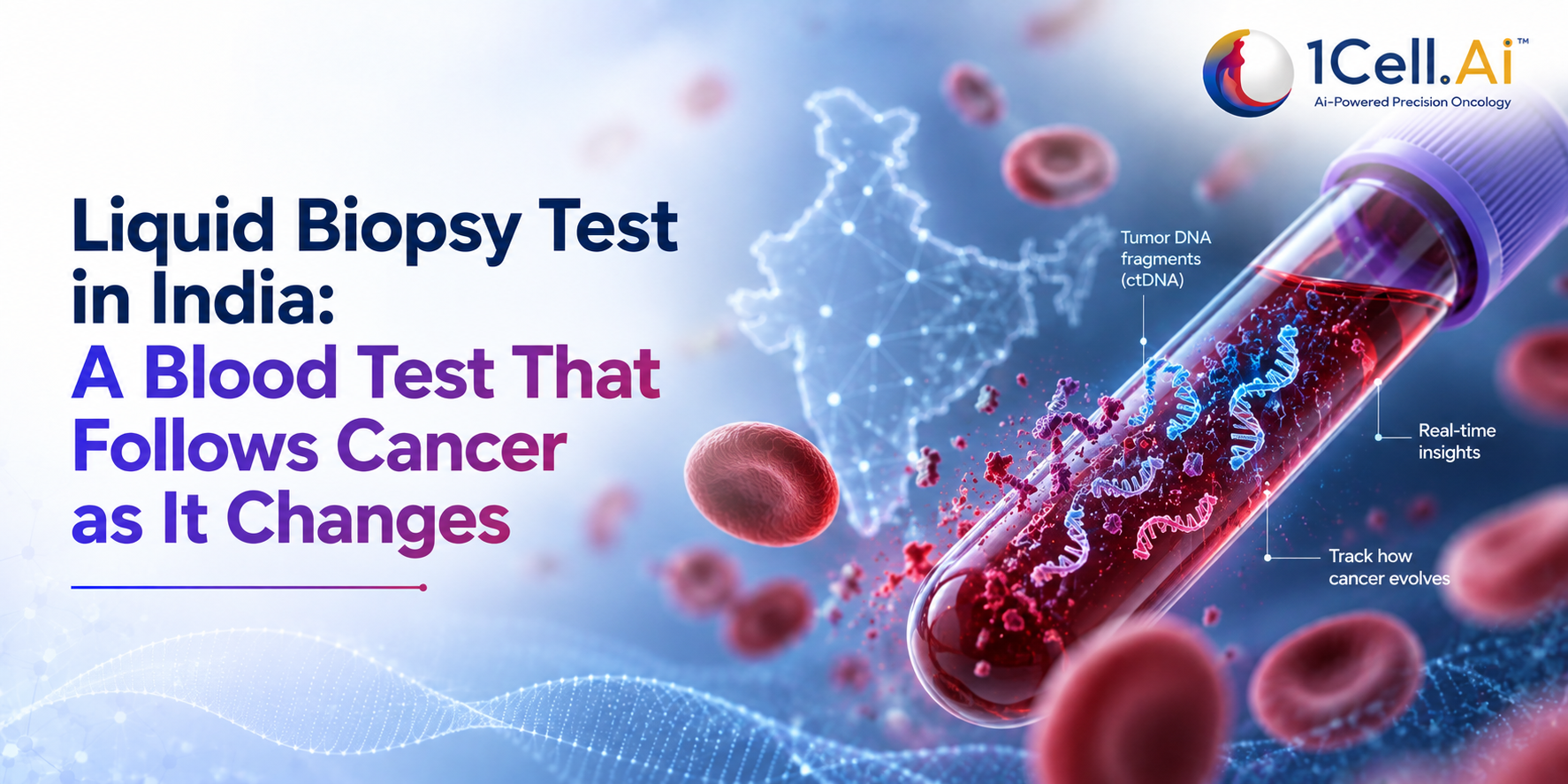
A liquid biopsy looks for the traces a Tumor leaves in the blood. Instead of taking a piece of the Tumor itself, it works from an ordinary blood draw.
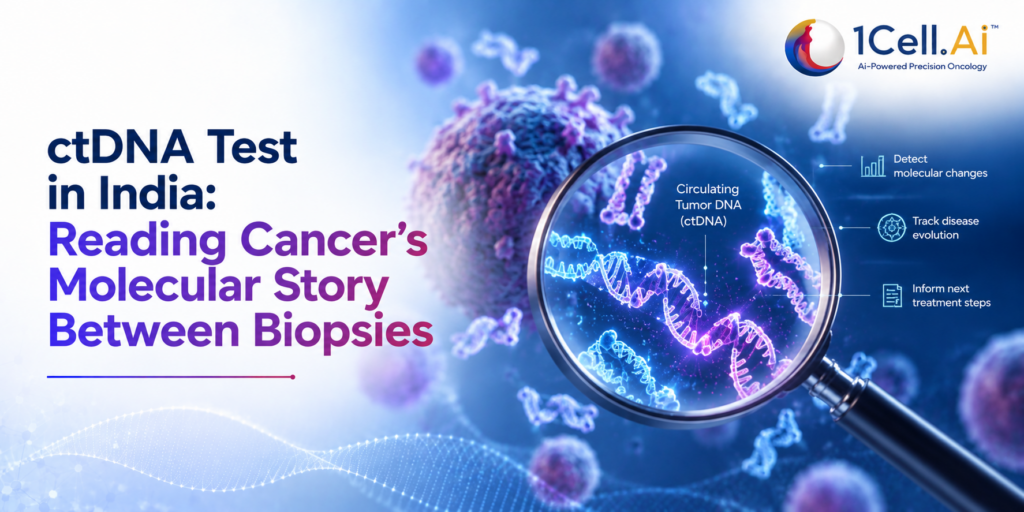
The signal that matters most is circulating Tumor DNA, or ctDNA (tiny fragments of Tumor DNA) that spill into the bloodstream as cancer cells grow and die. These sit within a wider pool of cell-free DNA (cfDNA) shed by cells throughout the body. Some platforms go further and capture circulating Tumor cells (CTCs) as well.
Put simply, a liquid biopsy reads a cancer’s genetic fingerprint from a tube of blood.
How does a liquid biopsy work?
For the patient, it’s just a blood test. The complexity is in the lab.
Blood is drawn, plasma is separated, and the cell-free DNA is pulled out. Next-generation sequencing (NGS) then reads those fragments and picks out mutations, copy-number changes, gene fusions and other relevant alterations, all in a single run.
The catch is that ctDNA usually shows up in very small amounts, especially early on or when there isn’t much disease. So the sensitivity of the test and the depth of sequencing count for a lot. As a rule, the more active the disease, the easier the signal is to find, and testing repeatedly over time tends to reveal far more than any one result.
Liquid biopsy vs tissue biopsy: what’s the difference?
None of this replaces tissue biopsy, imaging or pathology. For confirming a brand-new cancer diagnosis, a tissue biopsy is still the reference standard.
The real difference is practical. A tissue biopsy is a procedure, and repeating it every time you want to check how the disease is shifting is often hard, sometimes risky, and occasionally just not possible — particularly when the Tumor is awkward to reach, the sample is too small, or the patient isn’t well enough.
A liquid biopsy only needs blood, so it can be done again and again. That one difference opens up a lot.
“A tissue biopsy gives us a snapshot. A liquid biopsy can help us follow the story.”
When is a liquid biopsy recommended?
It tends to be most useful when a fresh tissue sample is difficult, risky, or simply not on the table; when tissue is too scanty for full testing; when an oncologist wants to track how a cancer is responding; or when a treatment has stopped working and the question is why.
It’s used across many advanced solid Tumors — lung cancer (including EGFR-mutated non-small cell lung cancer), colorectal, breast and others — where spotting an actionable mutation can point directly to a targeted therapy.
What can a liquid biopsy detect?
Depending on the cancer and the platform, a liquid biopsy can surface a few different things.
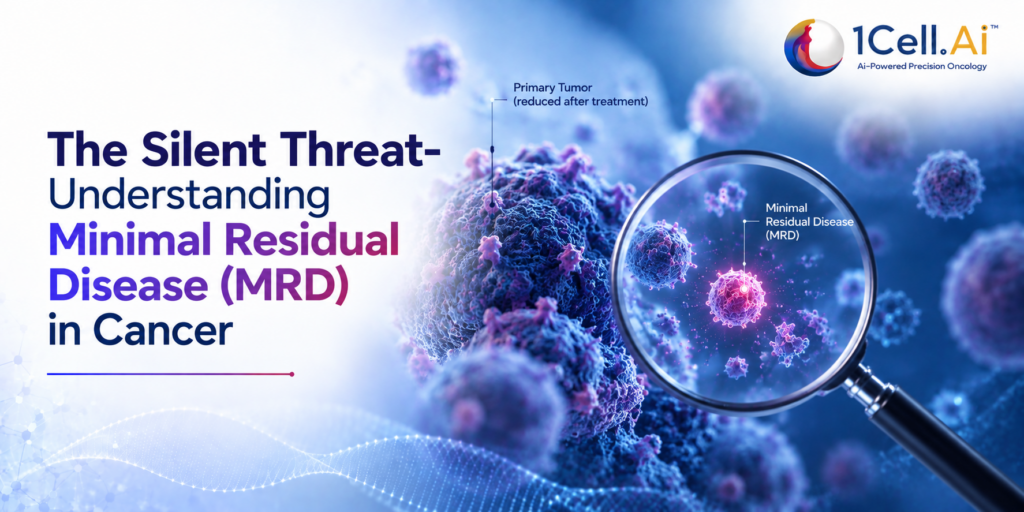
It can flag actionable alterations — the mutations, copy-number changes and fusions that open the door to targeted treatment. It can catch resistance early, when a new change appears as the Tumor adapts and helps explain why a drug has stopped holding. It can hint at response, through shifts in Tumor DNA over time. And highly sensitive approaches to pick up minimal residual disease (MRD), the faint traces left after treatment, sometimes before anything shows on a scan, are being actively developed and studied.
But maybe the most useful thing it offers isn’t any single result. It’s the trajectory and the ability to watch how a cancer is changing rather than reading each test in isolation.
Why does this matter in cancer care?
A lot of oncology still leans on a picture taken at one moment: profile the Tumor at diagnosis, pick a treatment, scan later to see if it’s working.
The trouble is that cancer doesn’t sit still. Under treatment, the sensitive cells shrink back while the resistant ones survive and spread. New alterations turn up; old ones fade.
“The Tumor we are treating today may not be the Tumor we diagnosed months ago.”
That shifts the question. Instead of only asking what mutations a Tumor has, clinicians can start asking how it’s changing and a repeatable blood test is what makes that question worth asking.
Liquid biopsy testing in India: what to keep in mind
India’s precision-oncology scene is growing fast, but cancer care here is anything but uniform. Patients arrive at different stages, tissue isn’t always available, and repeat molecular testing during treatment is often needed but not always easy to arrange. A blood-based test fits neatly into those gaps, and modern platforms in the country use NGS to profile cfDNA/ctDNA broadly, without another invasive procedure where that’s appropriate.
Two things are worth remembering. Cost and scope vary a great deal and a single-gene ctDNA test is a very different thing from a comprehensive NGS panel covering hundreds or thousands of genes. And a liquid biopsy isn’t a blanket replacement for tissue testing. Some Tumors shed very little ctDNA, and a negative result doesn’t prove an alteration is absent; it only means the blood didn’t show it.
“A negative result is information, not a conclusion.”
OncoIndx®: how 1Cell.Ai approaches liquid biopsy
At 1Cell.Ai, the aim isn’t to hand back the longest possible list of mutations. It’s to make the blood sample genuinely useful in the clinic.
With OncoIndx®, liquid-biopsy cfDNA can be analyzed, alongside tissue when it’s available, using a proprietary panel of more than 1,000 cancer-relevant genes covering SNVs, INDELs, CNVs, fusions and other clinically relevant biomarkers. Rather than checking a handful of hotspots, it casts a much wider net for the alterations and resistance mechanisms that might change a treatment plan.
Because ctDNA turns up in such small amounts, depth is everything. The current India platform runs at roughly 10,000× mean sequencing depth for liquid biopsy, which helps surface low-frequency variants that shallower tests can miss.
And since cancer doesn’t always slip past treatment through a DNA change alone, OncoIndx® sits within a broader multi-omic capability including CTC analysis and DNA, RNA and protein profiling where it’s clinically appropriate so the disease can be read from more than one angle. The reports are built around what’s actionable and tied to clinical evidence, so they fit how oncologists actually decide.
What it means for physicians and patients
For an oncologist, the payoff is a more up-to-date view of the disease. Is there an actionable alteration? Has the molecular picture moved during treatment? Could a new resistance mechanism explain why things are progressing? Is another tissue procedure really needed, or can blood answer part of the question first?
For patients, the benefit is quieter but real. A blood draw can offer molecular insight without automatically meaning another invasive procedure, and because blood can be taken again, testing can follow the cancer as it changes instead of resting on one snapshot from diagnosis.
None of this is unique to India. Tumors evolve under treatment everywhere, and the value of following that evolution travels well beyond one country which is why the technologies 1Cell.Ai is building are designed with that wider relevance in mind, while staying honest about what the science can and can’t yet support.
Because cancer changes.
“The test we use to understand it should be able to change with it.”
Frequently asked questions about liquid biopsy in India
How much does a liquid biopsy test cost in India?
Pricing varies widely by test type. A focused single-gene ctDNA test is generally less expensive, while a comprehensive NGS panel covering hundreds or thousands of genes costs more, reflecting its broader coverage and greater sequencing depth. As a general market reference, liquid biopsy tests in India typically range from around ₹15,000 to ₹60,000 or more. It’s best to confirm current pricing directly with the testing provider.
Is a liquid biopsy as accurate as a tissue biopsy?
Accuracy depends a lot on how much ctDNA a Tumor is shedding, which is tied to how much disease is present so sensitivity is usually stronger in advanced disease than in early-stage cancer. A liquid biopsy is a strong tool for finding actionable mutations and monitoring treatment, but a negative result doesn’t rule out an alteration, and findings should always be read alongside imaging, pathology and clinical history.
Can a liquid biopsy replace a tissue biopsy?
Not entirely. Tissue biopsy remains the definitive step for confirming a new cancer diagnosis. A liquid biopsy complements it as it is minimally invasive and a repeatable way to profile the disease and track how it changes, especially when tissue is hard to obtain.
Which cancers can a liquid biopsy be used for?
It’s used across many advanced solid Tumors, including lung (notably EGFR-mutated NSCLC), colorectal, breast, ovarian and others. Your oncologist chooses the right panel based on the cancer type and treatment stage.
Is a liquid biopsy a blood test?
Yes. A liquid biopsy is done on a blood sample, analyzing Tumor-derived DNA (ctDNA) and other molecular signals. It’s non-invasive and can be repeated over the course of treatment.