

Table of Contents
ToggleImagine a missile that can identify a specific house in an entire city, fly directly to it, and deliver its payload without damaging the surrounding neighborhood.
That is the promise of Antibody-Drug Conjugates (ADCs).
For decades, cancer treatment largely relied on chemotherapy; drugs that attack rapidly dividing cells, whether they are cancerous or healthy. ADCs are changing that paradigm by combining the precision of targeted therapy with the potency of chemotherapy.
The results have been remarkable.
Today, ADCs are among the fastest-growing classes of cancer therapeutics, with more than 14 FDA-approved ADCs and hundreds of candidates in development worldwide. Some experts believe ADCs could become the backbone of treatment for multiple solid tumors over the next decade.
But there is a catch.
An ADC is only as good as the target it can find.
And that is where protein expression becomes everything.
What Are Antibody-Drug Conjugates (ADCs)?
The Smart Bomb Analogy: How ADCs Work:-
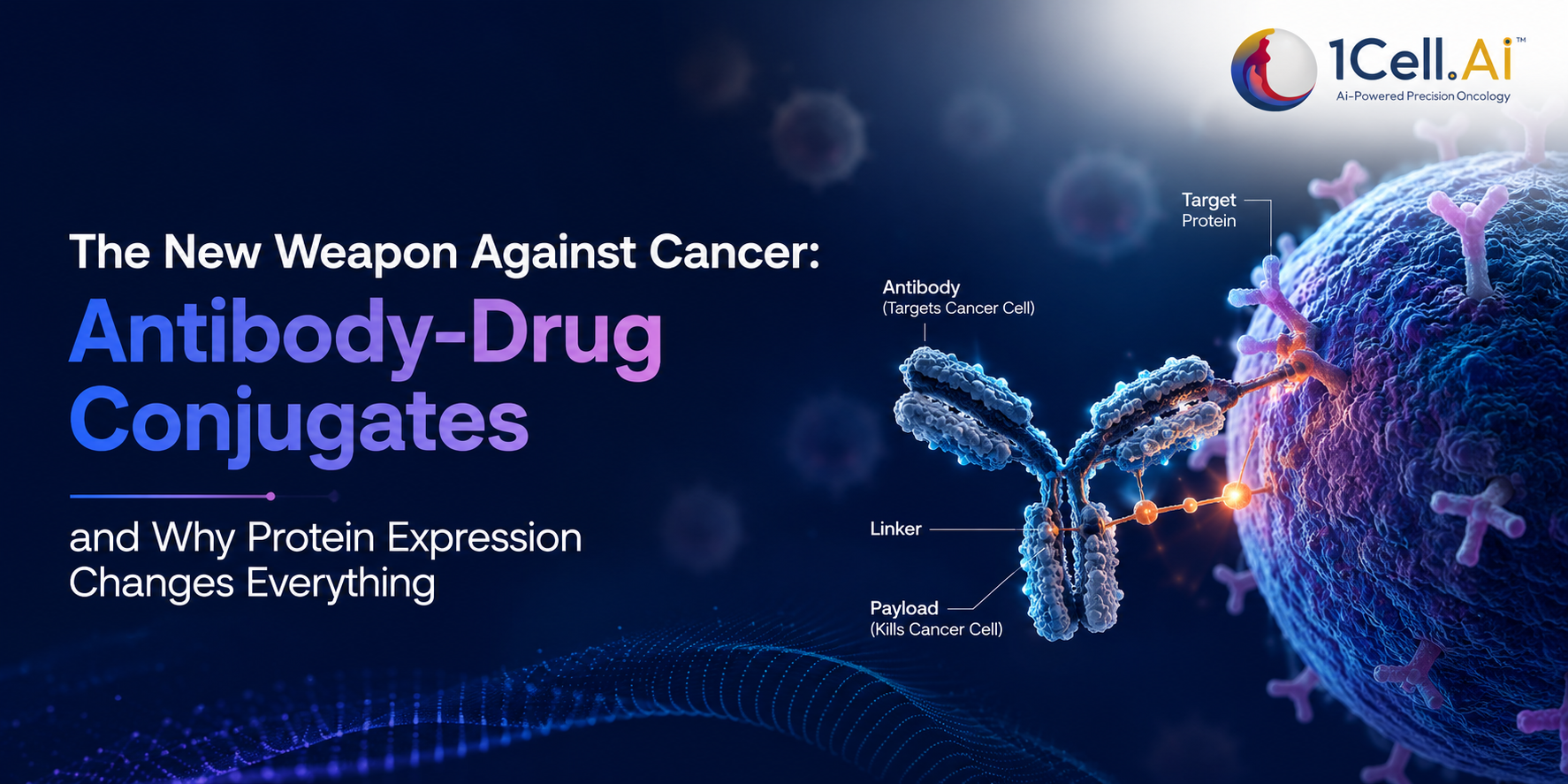
An ADC consists of three components:
| Component | Function |
| Antibody | Identifies q specific protein on cancer cells |
| Linker | Connects antibody to drug |
| Payload | Highly potent anti-cancer drug |
Cancer Cell → Target Protein Detected → Antibody Binds → ADC Internalized → Payload Released → Cancer Cell Dies
Instead of exposing the entire body to chemotherapy, ADCs attempt to deliver the drug directly to cancer cells.
This is why ADCs are often described as “smart bombs” in oncology.
Why ADCs Are Taking Oncology by Storm
Several factors are driving ADC adoption:
- Better precision: ADCs can target cancer cells expressing specific proteins while sparing many normal cells.
- Stronger payloads: Many ADC payloads are too toxic to administer systemically. The antibody acts as a delivery vehicle.
- Expanding targets: Initially limited to HER2-positive cancers, ADCs are now targeting proteins such as HER2, TROP2, Nectin-4, BCMA, FRα, LIV-1, and many others.
FDA-Approved ADCs Changing Cancer Treatment Today
Some of the most impactful ADCs include:
| ADC | Target | Cancer type |
| Enhertu (trastuzumab deruxtecan) | HER2 | Breast, gastric, lung |
| Kadcyla (T-DM1) | HER2 | Breast |
| Trodelvy | TROP-2 | Breast |
| Padcev | Nectin-4 | Urothelial cancer |
| Elahere | FRα | Ovarian cancer |
| Datroway | TROP-2 | HR+/HER2- breast cancer |
Datroway became one of the newest FDA-approved ADCs in breast cancer in 2025.
The Challenge: Finding the Right Target
The success of an ADC depends on one simple question:
“Is the target protein actually present on the tumor cell?”
If the target is absent, the ADC becomes a guided missile with no address.
Why Protein Expression on Tumor Cells Matters
ADCs do not target DNA mutations. They target proteins. This distinction is critical. A patient may have:
- The same mutation
- The same diagnosis
- The same tumor type
Yet express completely different levels of the target protein. And protein expression can change over time.
TUMOR EVOLUTION:
Initial Diagnosis → Treatment → Tumor Adapts → Protein Expression Changes → Drug Response Changes
This dynamic nature of cancer creates a major challenge for ADC therapy selection.
HER2-Ultralow, PD-L1, and the New Era of Biomarker Testing
Perhaps the best example is HER2. Historically, breast cancers were classified simply as:
- HER2 Positive
- HER2 Negative
But ADCs changed the rules.
Researchers discovered that even cancers with extremely low HER2 expression could benefit from HER2-targeted ADCs. This led to entirely new categories:
- HER2-Low
- HER2-Ultralow
In January 2025, the FDA expanded approval of Enhertu to include patients with HER2-ultralow metastatic breast cancer, creating a completely new treatment population. Even more striking:
Studies suggest that 35.5% of primary HER2-IHC 0 tumors and 49% of metastatic HER2-IHC 0 tumors may actually be reclassified as HER2-ultralow upon closer evaluation. A tiny difference in protein expression can now determine whether a patient receives a life-changing therapy.
Why Tissue Biopsy Falls Short for ADC Selection
Traditional tissue biopsy has several limitations:
- Single Snapshot Problem: A biopsy captures one location, one moment in time. Cancer is rarely that simple. Different metastatic sites may express different proteins.
- Repeat Biopsies Are Difficult: Challenges include; Invasive procedures, patient discomfort, procedure risks and limited repeat sampling. This makes continuous monitoring nearly impossible.
Circulating Tumors Cells and Protein Profiling
What CTC Protein Expression Reveals
Circulating Tumor Cells (CTCs) are cancer cells that detach from tumors and enter the bloodstream. Unlike tissue biopsy, CTCs offer a real-time window into tumor biology.
Protein profiling of CTCs can reveal:
✓ Target expression
✓ Emerging resistance
✓ Tumor heterogeneity
✓ Dynamic treatment response
All from just a blood sample.
Real-Time Protein Monitoring: Why It Changes Drug Development:-
For pharmaceutical companies developing ADCs, one of the biggest challenges is identifying:
- Which patients respond?
- Which patients don’t?
- Why resistance develops?
CTC-based protein monitoring enables serial sampling throughout treatment. Instead of measuring a biomarker once, researchers can track its evolution over time. This could dramatically improve:
- Clinical trial design
- Patient stratification
- Biomarker validation
- Drug development efficiency
PD-L1 on CTCs vs PD-L1 on Tissue: A Critical Difference
PD-L1 illustrates another important challenge. PD-L1 expression can vary significantly:
- Between primary and metastatic lesions
- Across tumor regions
- During treatment
A tissue sample obtained months earlier may no longer reflect current biology.
CTCs provide a dynamic assessment of protein expression, potentially offering a more representative picture of the disease state. This is increasingly important as biomarker-guided therapies continue to expand.
AI-Powered Biomarker Discovery for ADC Development
The next generation of ADCs will depend on finding entirely new targets. And that is where AI enters the picture.
How AI Identifies New ADC Targets
Modern cancer datasets include: Genomics, Transcriptomics, Proteomics and Clinical outcomes.
AI can analyze millions of data points simultaneously to identify proteins that are:
✓ Highly expressed on tumor cells
✓ Minimally expressed on healthy tissue
✓ Associated with treatment response
✓ Suitable for ADC targeting
This dramatically expands the universe of potential ADC targets.
From Biomarker to Drug Candidate- Shortening the Timeline
Traditional biomarker discovery often takes years.
AI enables researchers to:
Multiomic Data → AI Analysis → Candidate Biomarker → Target Validation → ADC Development
By prioritizing the most promising candidates early, development timelines can potentially be reduced while improving success rates.
How 1Cell.Ai is Enabling ADC Development
Simultaneous DNA, RNA, and Protein Analysis From Blood
At 1Cell.Ai, our Cell Biopsy® technology goes beyond conventional liquid biopsy in a way that is uniquely relevant to ADC development. From a single blood draw, our OncoIncytes platform simultaneously captures and analyses:
- DNA: identifying the mutations driving tumor biology
- RNA: measuring gene expression at the transcriptomic level
- Proteins: quantifying surface protein expression on live, individual CTCs
This third layer; protein analysis at single-cell resolution, is what makes our platform uniquely powerful for ADC target identification and patient selection. We can measure whether a patient’s CTCs express HER2, PD-L1, TROP-2, or any other ADC target, at what level, across what proportion of cells, and how that expression evolves over time.
Our Work in HER2-Ultralow Detection: OncoPredikt®
The HER2-ultralow story illustrates exactly why protein expression precision matters and why visual pathology assessment alone is no longer sufficient.
In our deep-learning model OncoPredikt®, presented at AACR 2026, we tackled one of the most clinically consequential diagnostic gaps in oncology: the inter-pathologist concordance rate for distinguishing HER2 0 vs HER2 1+ stands at just 26%. That’s barely better than chance and in the era of HER2-ultralow ADC therapy, it means patients who qualify for life-saving treatment are routinely misclassified.
OncoPredikt® results speak for themselves:
- Dice Similarity Coefficient >0.8 on whole-slide image tumor detection
- HER2-ultralow positivity detected in samples that pathologists had scored as HER2 0 (negative)
- Strong concordance with pathologist ER/PR and Ki67 scoring: validating the model’s biological accuracy.
The data is clear: in HER2-ultralow patients treated with Enhertu, 66% had tumor shrinkage compared to 31% with chemotherapy and median progression-free survival was 15.1 months versus 8.3 months. These are patients whose lives can be transformed, but only if they are correctly identified. OncoPredikt® exists to make sure no eligible patient is left behind by a misclassification.
Partnering With Biopharma for Smarter Clinical Trials
For biopharma companies developing the next generation of ADCs, we offer something no conventional diagnostic platform can: real-time, blood-based protein expression profiling from live single CTCs- at the sensitivity needed to find the patients who truly express the target, and monitor them longitudinally throughout the trial.
Our validated platform, CLIA-certified Foster City laboratory, and 1,080-gene OncoIndx NGS panel integrated with single-cell proteomics create a turnkey solution for ADC clinical trial companion diagnostics from patient selection through treatment monitoring to resistance profiling.
The Future of ADCs and Precision Oncology
Personalizing ADC Therapy for Every Patient
The future is unlikely to be:
“Which ADC should we give for this cancer type?”
Instead, it may become:
“Which ADC matches this patient’s unique protein-expression profile today?”
That shift is the essence of precision oncology.
What the Next Generation of ADCs Will Look Like
Several trends are already emerging like:
| Future trend | Impact |
| Multiple target ADCs | Reduced resistance |
| AI-discovered targets | Larger treatment populations |
| Dynamic biomarker monitoring | Better patient selection |
| Liquid biopsy guided treatment | Real-time therapy adjustment |
| Ultra sensitive protein profiling | Detection of new target populations |
Conclusion
ADCs are transforming cancer treatment by combining the precision of targeted therapy with the power of cytotoxic drugs.
But their success depends on something deceptively simple:
finding the right target at the right time in the right patient.
As oncology moves beyond broad disease categories toward protein-defined patient populations, biomarker detection becomes as important as the drug itself. Getting a patient onto the wrong ADC because their target protein was misclassified is not just a wasted treatment; it’s a missed window.
The rise of HER2-ultralow disease has already shown that tiny differences in protein expression can unlock entirely new treatment opportunities.
And as liquid biopsy, CTC profiling, multiomic analysis, and AI-powered biomarker discovery continue to advance, the future of ADCs may no longer be defined by the drug alone.
It will be defined by how precisely we can identify the patients who stand to benefit from it.