

Table of Contents
ToggleThe scans are clear. The treatment is done.
So why doesn’t it feel like it’s over?
There is a moment, usually in the car ride home from the oncologist’s office – when it hits you.
The treatment is finished. The scans are clear. By every clinical measure, you are cancer free.
And yet something doesn’t feel resolved.
Nobody prepares you for this part. The world expects celebration. You feel something closer to a low, persistent hum of what if.
- What if it’s still there, too small to see?
- What if the next scan is the one that changes everything?
- What if “cancer-free” is just another way of saying “we can’t find it right now”?
Here is the thing nobody tells you: that instinct is not irrational. It is biology.
“Cancer-Free” Is Not the Same as “Cancer Gone”
Imaging technology- the CT scans, PET scans, and MRIs that form the backbone of most post-treatment surveillance, can only detect a tumour once it contains roughly a billion cancer cells. Below that threshold, cancer can exist in the body and be completely invisible to every scan your oncologist orders.
This is not a flaw in the technology. It is simply the nature of what imaging was designed to do.
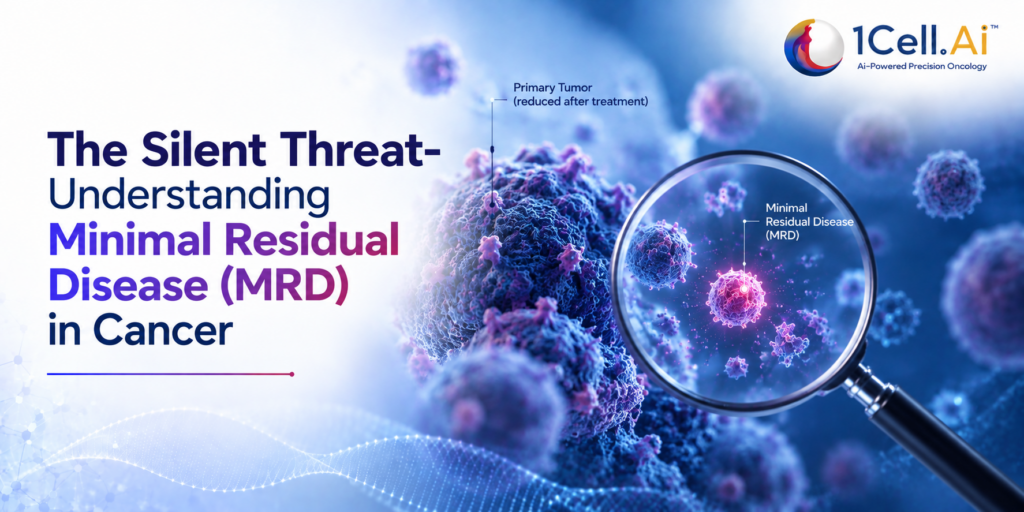
The gap between “we can’t see it” and “it’s truly gone” has a name in oncology: Minimal Residual Disease (MRD). It refers to the microscopic traces of cancer; individual cells or fragments of cancer DNA; that can remain in the body after treatment, quietly present, waiting.
Not every patient who is “cancer-free” has MRD. But some do. And until recently, there was no reliable way to know which group you were in.
The Anxiety Has a Scientific Name Too
Oncologists call it fear of cancer recurrence (FCR): and it is one of the most common and least-addressed experiences in survivorship. Studies show it affects up to 70% of cancer survivors, often persisting for years after treatment ends.
It is not weakness. It is not catastrophising. It is a rational response to an unresolved question that your surveillance plan may not yet be equipped to answer.
The standard post-treatment follow-up:- scans every few months, tumour marker checks, physical examinations, was designed to detect recurrence once it has already grown large enough to be visible. It was not designed to detect it at its earliest, most treatable molecular moment.
What Has Changed, And Why It Matters Now?
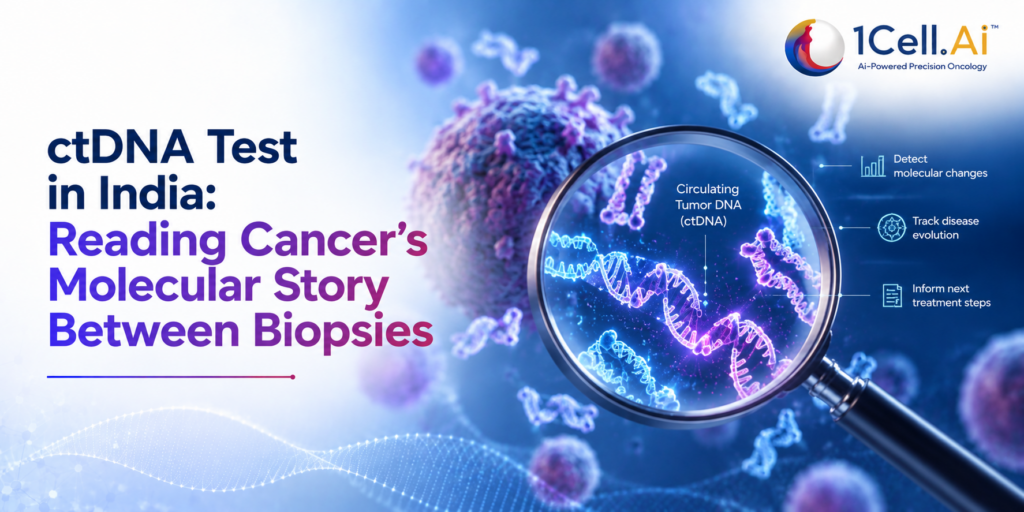
The science of cancer monitoring has moved significantly in recent years. Liquid biopsy– the analysis of cancer DNA and cancer cells circulating in the bloodstream has made it possible to detect traces of disease at levels as low as 0.001% tumour fraction, months before a scan would show anything.
In breast cancer, studies have shown ctDNA can detect recurrence up to 18.5 months before clinical or radiological evidence appears. That lead time is not a minor detail- it is the window in which treatment is most likely to work.
For survivors living with fear of recurrence, this represents something genuinely new: the possibility of a more reassuring “all clear.” Not based on what a scan can see; but on what the blood can tell us at the molecular level.
A negative molecular MRD result, repeated over time, carries a different weight than a negative scan. It is not just “we can’t see it.” It is “we looked at the cellular level, and it is not there.”
You Are Allowed to Want More Certainty
Cancer survivorship is not a single moment. It is a process- one that deserves the same level of scientific rigour as the treatment that came before it.
If the surveillance plan you are on doesn’t feel like enough, you are allowed to ask for more. You are allowed to ask about ctDNA testing, about MRD monitoring, about what liquid biopsy options exist for your cancer type and stage.
The most important conversation in cancer care is not always the one about treatment. Sometimes it is the one about what happens after, and whether you are being watched over as carefully as you deserve.
At 1Cell.Ai, our OncoMonitor® platform is built for exactly this- longitudinal molecular monitoring from a blood draw, designed to give survivors and their oncologists the clearest possible picture of what is happening between the scans.