The Problem That Millions of Patients Face Every Day
Every year, thousands of women diagnosed with early-stage breast cancer face a critical question after surgery:
Do I need chemotherapy?
Genomic assays like Oncotype DX and MammaPrint are the gold standard for answering that question -analysing the biology of the tumour to predict recurrence risk and guide chemotherapy decisions with a level of precision that clinico-pathological factors alone cannot provide.
But there is a profound problem.
These tests are expensive, require specialised sequencing infrastructure, and have long turnaround times. For patients in low- and middle-income settings, including large parts of India and the developing world – they are simply out of reach.
Thousands of women either forego the test entirely or make chemotherapy decisions without the genomic guidance that could spare them unnecessary treatment or catch them before it’s too late.
At 1Cell.Ai, we set out to solve this. The result is TRINITY AI.
Introducing TRINITY AI – Precision Oncology From a Standard Slide
TRINITY AI is our proprietary multimodal deep-learning platform that delivers genomics-grade breast cancer recurrence stratification directly from a standard H&E-stained tissue slide- the most universally available diagnostic tool in pathology, present in virtually every hospital in the world.
No sequencing. No additional infrastructure. No weeks of waiting.
TRINITY AI integrates three powerful data streams simultaneously:
Tissue morphology: extracted from digitised H&E whole-slide images using a self-supervised transformer foundation model
AI-inferred transcriptomic signatures: gene expression patterns predicted directly from the H&E image, without any sequencing
Clinical variables: including age, tumour size, grade, and nodal status
From these three inputs, TRINITY AI generates a BreastRS score- a continuous 0-100 recurrence risk score that mirrors the clinical utility of Oncotype DX, telling oncologists which patients are at low risk and can safely avoid chemotherapy, and which are at high risk and need it most.
How We Built and Validated TRINITY AI:
TRINITY AI was trained on 1,219 early-stage breast cancer cases from TCGA and CPTAC: two of the most comprehensive and well-characterised cancer genomics datasets in the world.
For diagnostic validation, three independent external cohorts (n=146) with matched Oncotype DX scores were used with strict slide quality control and pathologist review to assess how well our BreastRS score correlates with and predicts Oncotype DX results.
For prognostic validation, we assessed performance in 1,051 TCGA cases with five or more years of follow-up, using multivariable Cox regression models for Distant Recurrence-Free Interval (DRFI)- adjusted for all standard clinico-pathological factors.
Results That Speak for Themselves
The performance of TRINITY AI across our validation cohorts is compelling:
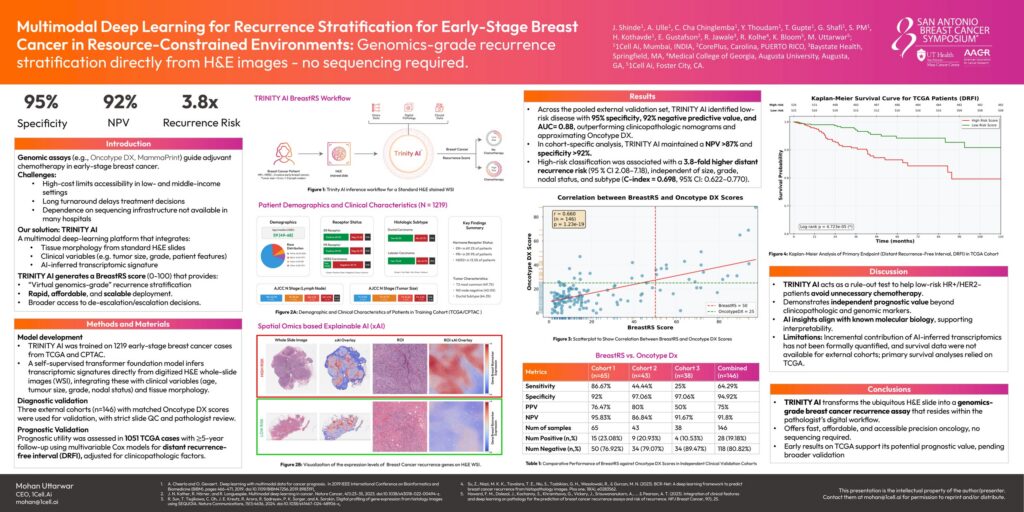
•95% specificity across the pooled external validation set: meaning the vast majority of truly low-risk patients are correctly identified
•92% Negative Predictive Value (NPV): meaning that when TRINITY AI says a patient is low risk, it is right 92% of the time
•AUC of 0.88: outperforming standard clinicopathological nomograms and closely approximating Oncotype DX performance
•In cohort-specific analysis, TRINITY AI maintained NPV >87% and specificity >92% consistently across all three external cohorts
•High-risk classification by TRINITY AI was associated with a 3.8-fold higher distant recurrence risk (95% CI 2.08–7.18) independent of tumour size, grade, nodal status, and subtype
•C-index of 0.698 (95% CI: 0.622–0.770): demonstrating strong independent prognostic discrimination
The scatterplot correlation between BreastRS and Oncotype DX scores further confirms that TRINITY AI is capturing the same biological signal as the gold standard genomic assay- without any sequencing at all.
What This Means for Patients and Oncologists?
TRINITY AI is designed to function as a rule-out test helping low-risk HR+/HER2- patients avoid unnecessary chemotherapy with confidence, while flagging high-risk patients who need more aggressive treatment.
For oncologists in resource-constrained settings, this changes everything.
A decision that previously required expensive genomic testing and weeks of waiting can now be made from a slide that already exists in the pathologist’s workflow – rapidly, affordably, and at scale.
For patients in India and across the developing world, TRINITY AI represents something deeply meaningful-access to genomics-grade precision oncology that was previously beyond their reach.
Explainability Built In
One of the features we are particularly proud of is TRINITY AI’s Spatial Omics-based Explainable AI (xAI) capability, which visualises the expression levels of breast cancer recurrence genes directly on the H&E whole-slide image.
This means oncologists can not only receive a risk score, but understand which regions of the tissue and which gene expression patterns are driving it – making the AI’s decision transparent, interpretable, and clinically trustworthy.
Looking Ahead
We are grateful to our collaborators at the Medical College of Georgia at Augusta University, Baystate Health, and CorePlus for their partnership in validating this work. The early results presented at SABCS 2025 represent an important milestone and we look forward to broader validation studies that will bring TRINITY AI closer to clinical deployment at scale.
“Precision oncology should not be a privilege.
TRINITY AI is our commitment to making sure it isn’t.”
Presented at the San Antonio Breast Cancer Symposium 2025
Presented by J. Shinde, G. Shafi, H. Kothavade, M. Uttarwar et al. | 1Cell.ai, Medical College of Georgia, Baystate Health, CorePlus | San Antonio Breast Cancer Symposium 2025