

A patient finishes a line of therapy. The scans look reassuring. On paper, things are stable. And yet the oncologist is left with a quiet, familiar uncertainty: is the cancer we are managing today still the same cancer we characterized months ago?
That question sits close to the heart of modern oncology, because a tumors is not a fixed object. It adapts. It develops resistance. Occasionally it returns while imaging still looks calm.
So how do we follow what a tumor is doing in the long gaps between biopsies and scans?
One increasingly useful answer lies in the blood.
Listening to the tumor through the blood
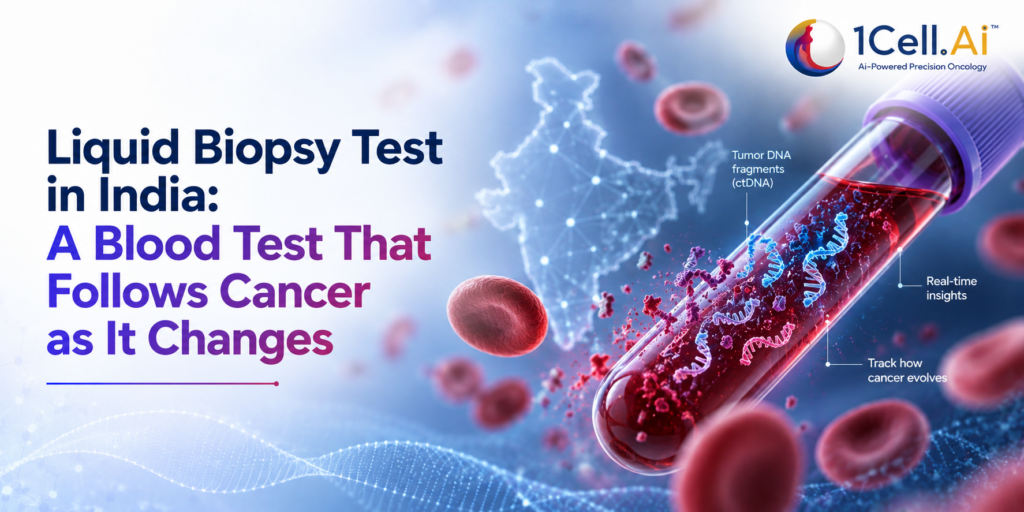
As tumor cells grow, divide and die, they shed fragments of DNA into the bloodstream. These fragments called circulating tumor DNA, or ctDNA, carry the genetic signatures of the cancer they came from.
A ctDNA test is a form of liquid biopsy that looks specifically for this tumor-derived DNA in a blood sample. It sits within a larger pool of cell-free DNA (cfDNA) released by cells throughout the body, healthy and malignant alike.
Here is the difficulty. In many patients, ctDNA makes up only a small fraction of the total cfDNA in circulation — sometimes a very small fraction. Detecting these low-frequency signals reliably is not trivial. It depends on highly sensitive molecular methods and enough sequencing depth to see what is actually there.
“Cancer may change faster than we can biopsy it. ctDNA offers a way to hear what the tumor is saying through the blood.”
From one mutation to the whole molecular picture
Early blood-based tests often asked narrow questions: is this one mutation present, or not?
That approach has its place. But cancer biology is rarely governed by a single alteration, and resistance seldom announces itself through one predictable change.
This is where NGS-based ctDNA testing earns its value. Rather than interrogating one hotspot at a time, comprehensive genomic profiling can examine hundreds to thousands of cancer-related genes in parallel looking for mutations, copy-number changes, gene fusions and other alterations that may shape treatment.
What can such a test actually tell a clinician? Depending on the assay and the clinical setting, ctDNA analysis may help identify potentially actionable alterations, flag molecular changes emerging under treatment, point to mechanisms of resistance, and give a sense of how tumor burden is shifting over time. When tissue is limited or unavailable, it can support molecular characterization that would otherwise be hard to obtain.
Why a repeatable test changes the question ?
A tissue biopsy is, by its nature, a snapshot. It captures the tumor at one moment, in one place.
A ctDNA test can, in principle, be repeated with a fresh blood draw rather than a fresh procedure. And that changes what we are able to ask.
Instead of only asking what the tumor looked like at diagnosis, we can begin to ask what it looks like now. This longitudinal view matters because treatment resistance is one of the central problems in oncology. A therapy may work well at first and then falter, as adaptable tumor cells survive the pressure and resistant clones expand.
The tumor has changed.
Serial ctDNA testing offers a way to look for those changes. If a new resistance-associated alteration appears in circulating tumor DNA, it may signal that the biology of the disease is shifting, sometimes before that shift is fully apparent clinically or on imaging.
ctDNA and tissue biopsy answer different questions
It would be a mistake to frame ctDNA as a straight replacement for tissue.
A tissue biopsy gives direct information about the tumor itself and remains central to diagnosis and molecular characterization. But obtaining tissue is not always simple. The tumor may sit in a difficult or risky location, the sample may be too scant for comprehensive testing, and repeated biopsies are often impractical.
ctDNA complements tissue. Because fragments can enter the bloodstream from more than one tumor site, a blood-based test may reflect molecular information from across the disease rather than from a single sampled area — a potential advantage in heterogeneous or metastatic cancers.
There is an important caveat here, and it deserves emphasis. A negative ctDNA result does not mean the cancer carries no genomic alterations. Tumor shedding into the blood varies with tumor type, location, disease burden and other biological factors, and some tumors shed little ctDNA even when they are clearly active.
“Detection is not the same as absence.”
That is why ctDNA findings should always be read alongside a patient’s clinical and pathological picture, never in isolation.
Why access to ctDNA testing matters in India
India has a large and remarkably varied cancer population. Yet access to repeated tissue biopsies and advanced molecular testing remains uneven.
For many patients particularly those with advanced, metastatic, recurrent or treatment-resistant disease obtaining adequate tissue for every molecular assessment can be genuinely difficult. A blood-based approach makes repeat molecular assessment more practical, and the growth of NGS-based liquid biopsy in India is helping bring comprehensive genomic profiling closer to everyday clinical decisions.
Even so, more genomic data is not automatically more useful. The real value of a ctDNA test lies in translating complex molecular findings into something a physician can act on.
How 1Cell.Ai approaches ctDNA testing
This is the problem 1Cell.Ai’s work is built around. The OncoIndx® platform pairs comprehensive genomic profiling with liquid biopsy analysis, using high-depth sequencing to detect low-frequency alterations in circulating tumor DNA. The current platform supports analysis across more than 1,000 cancer-related genes, with liquid-biopsy sequencing at approximately 10,000× depth. That depth matters precisely because tumour-derived DNA may account for only a small share of the cfDNA in a sample; shallow sequencing risks missing the very signals that count.
For more complex cases, OncoIndx® Prime+ goes further, integrating tissue, liquid biopsy/ctDNA and matched normal DNA in a single analysis. Comparing tumor signal against a patient’s own normal DNA helps distinguish somatic alterations from germline or background variation — an important distinction when a finding may influence treatment.
Genomic complexity is only useful if it can be understood. Findings are interpreted through the iCare™ AI reporting platform, which is designed to turn dense molecular data into clinician-ready information, including treatment-relevant insights and resistance-related findings.
The aim is not to generate a longer list of variants. It is to help answer the questions that matter at the bedside: What is driving this cancer? Is there a potentially actionable alteration? Could the tumour be developing resistance? Can we learn something useful without another invasive biopsy? And, perhaps most important of all — has the biology of this patient’s cancer changed?
What this means for physicians and patients
For oncologists, a ctDNA test is another molecular tool that complements pathology, imaging and tissue sequencing rather than competing with them. Used thoughtfully, it can support treatment-related decisions, help monitor disease biology over time, and offer molecular information when tissue is scarce or repeat sampling is not feasible.
For patients, the appeal is more human. A blood draw is less invasive than a repeat biopsy. And because it can be repeated when clinically appropriate, it opens the possibility of following the disease more closely with molecular information that reflects the cancer as it is now, not only as it was at diagnosis.
A longitudinal future — in India and beyond
Precision oncology is gradually shifting from a single molecular snapshot toward a more continuous understanding of how a tumour evolves. ctDNA testing is central to that shift, and its logic is not confined to any one country. Tumours adapt under treatment everywhere.
What 1Cell.Ai brings together — liquid biopsy, comprehensive NGS, deep sequencing, AI-assisted interpretation and longitudinal monitoring — is designed to support treatment planning, resistance detection, response monitoring and recurrence surveillance across the cancer journey. In India, where minimally invasive and clinically interpretable molecular testing can ease real practical constraints, that has particular value. The same scientific foundation carries relevance well beyond it.
Because cancer does not stand still, molecular profiling shouldn’t either.
A blood sample may be small. The story it carries is not.